


Exercises
 : shows the complete answer. |  : gives a hint |
 : plays a video solution |  : shows just the final answer |
 : these are important examples that illustrate new concepts, you should be sure to review the solutions to these questions | |
Exercises
Suppose that $\int_1^3 f(x) = 4$, $\int_3^6 f(x) = 2$ and $\int_3^8 f(x) = 5$. Find the following definite integrals.
|
|
|
Suppose that $\int_0^3 f(x) = 2$, $\int_0^5 f(x) = 6$ and $\int_3^6 f(x) = 3$. Find the following definite integrals.
|
|
|
Suppose that $\int_1^5 f(x) = 3$, $\int_1^5 g(x) = -4$ and $\int_1^5 h(x) = -1$. Find the following definite integrals.
|
|
|
Use known area formulas to evaluate the following integrals.
|
|
|
|
|
|
|
|
|
|
|
|
Explorations
- Use the min/max property to show that if $f(x) \ge 0$ on the interval $[a, b]$ then $\int_a^b f(x) dx \ge 0$.
- Use the previous result to show that if $f(x) \le 0$ on the interval $[a, b]$ then $\int_a^b f(x) dx \le 0$.
- Suppose $f(x)$ is a strictly increasing function. Show that $\int_a^b f(x) dx \le \int_a^c f(x) dx$ if $b \le c$. In other words, if the function is increasing everywhere then the area under the curve is also increasing everywhere.
- Evaluate $\int_0^3 x dx$ using known area formulas. Find an antiderivative, $F(x)$, of $x$. What relationship do you see between the area and the values of $F(0)$ and $F(3)$?
- Evaluate $\int_1^4 x dx$ using known area formulas. Find an antiderivative, $F(x)$, of $x$. What relationship do you see between the area and the values of $F(1)$ and $F(4)$?
- Looking back at the previous two questions, did the constant of integration affect the result? Why?
When we started talking about differentiation, one of the first things we saw was that not all functions are differentiable. Whether or not a function is integrable is also an important question but it's also a more complicated one. We saw earlier that being discontinuous automatically means a function isn't differentiable. The next several questions investigate the relationship between integrability and continuity. As you'll see, discontinuity isn't always a bar to being integrable.
- Evaluate $\int_{0}^3 f(x) dx$ where $f(x) = \begin{cases} x + 2, & x \le 1 \\ -x + 3, &x \gt 1 \end{cases}$ using known area formulas.
- Evaluate $\int_{0}^3 f(x) dx$ where $f(x) = \begin{cases}
1, & x \le 1 \\
2, & 1 \lt x \le 2 \\
3, & x \gt 2
\end{cases}$ using known area formulas.
- What do the previous two results suggest about the affect of a discontinuity on the integrability of a function?
 Let $f(x) = \frac{1}{x}$ and consider $\int_0^1 f(x) dx$. Why isn't possible to evaluate this area use left Riemann sums?
- Nonintegrable functions Consider the function $f(x) = \begin{cases}
1, x \text{ is irrational} \\
0, x \text{ is rational}
\end{cases}$. Use left Riemann sums for this function on the interval $[\sqrt{2}, \sqrt{2} + 1]$ to get one value for its area. Next, use left Riemann sums to get a value for the area on the interval $[0, 3]$. What do these results suggest about the integrability of the function?
Icons courtesy of icons8.com
Suppose that $\int_1^3 f(x) = 4$, $\int_3^6 f(x) = 2$ and $\int_3^8 f(x) = 5$. What is $\int_1^6 f(x) dx$?
$$\int_1^6 f(x) dx = \int_1^3 f(x) dx + \int_3^6 f(x) dx = 4 + 2 = 6$$
Suppose that $\int_1^3 f(x) = 4$, $\int_3^6 f(x) = 2$ and $\int_3^8 f(x) = 5$. What is $\int_6^8 f(x) dx$?
$$\int_6^8 f(x) dx = \int_3^8 f(x) dx - \int_3^6 f(x) dx = 5 - 2 = 3$$
Suppose that $\int_0^3 f(x) = 2$, $\int_0^5 f(x) = 6$ and $\int_3^6 f(x) = 3$. What is $\int_5^3 f(x) dx$?
$$\int_5^3 f(x) dx = -\int_3^5 f(x) dx = -\left(\int_0^5 f(x) dx - \int_0^3 f(x) dx\right) = -(6 - 2) = -4$$
Suppose that $\int_1^5 f(x) = 3$, $\int_1^5 g(x) = -4$ and $\int_1^5 h(x) = -1$. What is $\int_1^5 (3f(x) + g(x)) dx$?
$$\int_1^5 (3f(x) + g(x)) dx = 3\int_1^5 f(x)dx + \int_1^5 g(x) dx = 3 \cdot 3 + (-4) = 5 $$
Suppose that $\int_1^5 f(x) = 3$, $\int_1^5 g(x) = -4$ and $\int_1^5 h(x) = -1$. What is $\int_1^5 (-2g(x))$?
$$\int_1^5 (-2g(x)) = -2\int_1^5 g(x) = -2 \cdot (-4) = 8 $$
Use known areas to evaluate $\int_1^4 (3x + 1) dx$
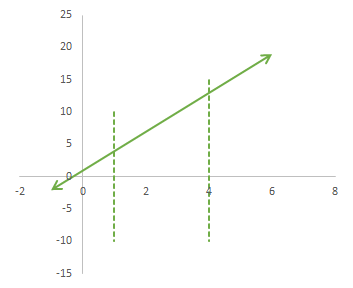
When I look at this image, I see a trapezoid turned on its side. The bases of the trapezoid are the two vertical lines whose heights are $f(1) = 4$ and $f(4) = 12$. The height is the distance between the $x$ bounds or $4 - 1 = 3$. IF we put those values into the formula for the area of a trapezoid, we get
$$\begin{aligned} \int_1^4 (3x + 1) dx &= \frac{h}{2}(b_1 + b_2) \\ &= \frac{3}{2} (4 + 12) \\ &= 24 \end{aligned}$$Use known areas to evaluate $\int_{-1}^3 |x| dx$
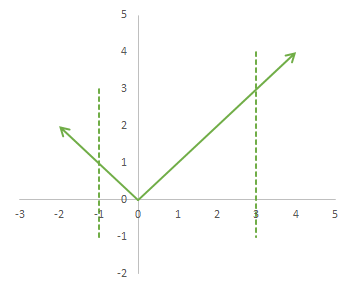
This figure is made up of two right triangles. The left hand one has base and height both equal to 1 and the right hand one has both values equal to 3. That makes the area
$$\begin{aligned} \int_{-1}^3 |x| dx &= \frac{1}{2} \cdot 1 \cdot 1 + \frac{1}{2} \cdot 3 \cdot 3 \\ &= 5 \end{aligned}$$Use known areas to evaluate $\int_{-2}^2 (|x + 1| - 1) dx$
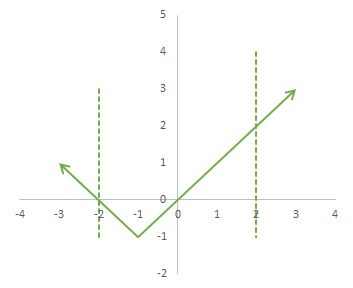
This figure is made up of two. The right hand one is a right triangle whose base and height are both two. The left hand triangle has a base whose length is 2 and whose height is $h=|f(-1)| = |-1|-1$. That makes the area
$$\begin{aligned} \int_{-2}^2 (|x + 1| - 1) dx &= \frac{1}{2} \cdot 2 \cdot 1 + \frac{1}{2} \cdot 2 \cdot 2 \\ &= 3 \end{aligned}$$Use known area formulas to evaluate $\int_0^4 \sqrt{16 - x^2} dx$.
The graph of $y = \sqrt{16 - x^2}$ or $x^2 + y^2 = 16$ is the upper half of a circle centered on the origin whose radis is 4 units. Since we only want the area from $x = 0$ to $x = 4$, that's the quarter circle in the first quadrant. The area of a quarter circle whose radius is 4 gives us
$$\int_0^4 \sqrt{16 - x^2} dx = \frac{1}{4}\pi \cdot 4^2 = 4\pi$$Use known area formulas to evaluate $\int_{0}^3 (mx) dx$, $m > 0$.
Since $m>0$ this is a straight line passing through the origin and into the first quadrant, regardless of the value of $m$. This means the upper bound of our shape is a line starting at $(0, 0)$ and going to $(3, 3m)$. The over all shape will be a right triangle whose base has length 3 (from $x = 0$ to $x = 3$) and whose height is $3m$. That makes the area
$$\int_0^3 3m dx = \frac{1}{2} \cdot 3 \cdot 3m = \frac{9m}{2}$$Use known area formulas to evaluate $\int_{0}^3 (mx + b) dx$, $m > 0$.
The function is a line going from $(0, b)$ to $(3, 3x + b)$. Since $b$ is strictly greater than 0, the y-intercept is above the x-axis making the shape a trapezoid whose bases are $b$ and $3m + b$ and whose height is $3 - 0 = 3$. That makes the area
$$\int_0^3 (mx + b) dx = \frac{h}{2}(b_1 + b_2) = \frac{3}{2}(b + 3m + b) = \frac{9m + 6b}{2}$$Use the min/max property to show that if $f(x) \ge 0$ on the interval $[a, b]$ then $\int_a^b f(x) dx \ge 0$.
The min/max property says that
0 mat not be the actual minimum but it's less than the minimum.Use the previous result to show that if $f(x) \le 0$ on the interval $[a, b]$ then $\int_a^b f(x) dx \le 0$.
Let $g(x) = -f(x)$. Then since $f(x) \le 0$ we have $-g(x) \le 0$ or $g(x) \ge 0$. This means that
$$\int_a^b f(x) dx = - \int_a^b g(x)$$By the previous result, $\int_a^b g(x) \ge 0$ which means that $-\int_a^b g(x) \le 0$ so $\int_a^b f(x) \le 0$.
Suppose $f(x)$ is a strictly increasing function. Show that $\int_a^b f(x) dx \le \int_a^c f(x) dx$ if $b \le c$. In other words, if the function is increasing everywhere then the area under the curve is also increasing everywhere.
What this is saying is that if the function is increasing then the area under the curve is also increasing.
Evaluate $\int_0^3 x dx$ using known area formulas. Find an antiderivative, $F(x)$, of $x$. What relationship do you see between the area and the values of $F(0)$ and $F(3)$?
The boundary curve is a straight line from $(0, 0)$ to $(3, 3)$. The shape is a triangle whose base and height are both 3 so the area is
$$A = \int_0^3 x dx = \frac{1}{2} \cdot 3 \cdot 3 = \frac{3^2}{2} = \frac{9}{2}$$Using the Power Rule, the antiderivatives of the original function are $F(x) = \frac{x^2}{2} + C$. If we let $C = 1$ (you can chose any value here) then $F(0) = 1$ and $F(3) = \frac{3^2}{2} + C$. Notice that $\frac{3^2}{2}$ this means that
$$A = F(3) - F(0)$$Looking back at the previous two questions, did the constant of integration affect the result? Why?
Ultimately, the constant doesn't matter since you always end up with $C - C$ when you subtract the two values.
Evaluate $\int_{0}^3 f(x) dx$ where $f(x) = \begin{cases} 1, & x \le 1 \\ 2, & 1 \lt x \le 2 \\ 3, & x \gt 2 \end{cases}$ using known area formulas.
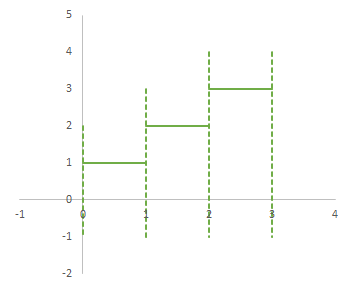
The shape is made up of three rectangles whose areas are 1, 2 and 3 so
$$\int_0^3 f(x) dx = 1 + 2 + 3 = 6$$The shapes are missing the 'ends' at $x = 0$ and $x = 3$ but those pieces all have a base of 0 so the missing area fro those two sections are both 0 so the fact that they're missing doesn't change the total area.
Let $f(x) = \frac{1}{x}$ and consider $\int_0^1 f(x) dx$. Why isn't possible to evaluate this area use left Riemann sums?
Any sequence of partitions has to start with $x = 0$ as the left-hand end point of the first segment in the partition. However, the function isn't defined at $x = 0$ so we can't calculate $f(x_1)$ for any left handed sequence of partitions.
