


Our classrooms section has a variety of free classrooms for use by students and their teachers. Our Short Courses are quick reviews of material that you'll find in other classes such as using linear equations and working with polynomials. They contain multiple examples and lists of steps for common procedures and have our signature dynamic practice areas that generate an almost unlimited number of practice questions along with their complete solutions. The classes in the Supplemental Curriculum take students through material not normally convered in a middle school or high school curriculum through a series of lectures that include real world applications and interactive modules.
Full CourseIn DepthShort CourseSupplemental Curriculum
Calculus 1
college (lower division)
 How fast is a function changing? It's a deceptively simple question that has applications in fields from physics to economics. First semester calculus, develops techniques for answering this question and looks at a variety of related applications.
 Discrete Math (In Progress)
undergraduate
 Discrete Math is a broad term that covers any field that works with discrete sets of objects. There are a lot of very distinct fields that meet that description. In this class, we''re going to touch on a selection of those fields including logic, set theory, sequences, combinatorics, number theory and finite state machines. Our focus is going to be on giving a survey of each topic with an eye toward computer science applications and introducing students to the basics of writing mathematical proofs
 Linear Algebra
undergraduate
 Linear Algebra is the study of systems of linear equations and the mathematical structures that arise from them. Although it began as a collection of techniques for solving systems of equations, it has grown into one of the most important subjects in modern mathematics with applications in science, engineering, computer graphics, machine learning, data analysis, and many other fields. In this class, we'll study systems of linear equations, matrices, vector spaces, linear transformations, eigenvalues and eigenvectors, and orthogonality. The emphasis will be on developing an understanding of these ideas through algebraic techniques, geometric intuition, and theoretical reasoning, allowing students to see how these different perspectives complement one another.
 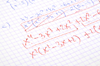 Polynomials are one of the building blocks of engineering. They can be used to model everything from the behavior of falling objects to complex dynamic systems. Our short course covers classification, addition and subtraction, multiplication, factoring and solving equations including the Quadratic Equation.
  This course is intended more as a reference to the various methods used to solve the variety of equations that come up in those classes rather than a stand alone class you would go through one lesson at a time. It starts with simple linear equations then works through systems of equations, polynomials, rational equations, equations with logarithms and exponents and, finally, trigonometric equations.
  This short course covers general topics from introductory mathematics and arithmetic such as fractions and percentages.
  Linear equations are an important part of every algebra class. Not only do they illustrate many basic algebra principles but they're a basic tool in mathematical modeling. They can be used to describe everything from the motion of cars to the cost of manufacturing processes. Our linear equations short course goes over all the fundamentals of working with this type of equation including finding the equation of a line and finding the intersection of two lines.
  Combinatorics, part of our Algebra 1 program, is the mathematical study of counting. Like number theory, this sounds deceptively simple. We all know how to count, right? Combinatorics includes formal methods for answering questions like, "How many ways can four boys and four girls be seated in a row if two boys and two girls can't sit next to each other?" where making a list would take days.