


Exercises
 : shows the complete answer. |  : gives a hint |
 : plays a video solution |  : shows just the final answer |
 : these are important examples that illustrate new concepts, you should be sure to review the solutions to these questions | |
Exercises
If $x$ and $y$ in the following expressions are functions of $t$, find $dy/dt$ or $dx/dt$ for the given value of the other rate.
|
|
|
|
|
|
- A particle is moving along the curve $y = \cos x$. How fast is the y-coordinate changing when $x = \pi/2$ and $dx/dt = .2$?
- How fast are the sides of an isosceles right triangle changing if the hypotenuse is 4 cm and is changing at a rate of 1.2 cm / sec?
- When a metal sphere is heated, its radius increases at a rate of 0.03 cm/sec. How fast is the volume changing when the radius is 6 inches?
- A rope attached to a 5' tall dock is being pulled in at a constant rate of 3 feet/sec. How fast is the boat approaching the dock when it's 20' away?
- Sand is falling from an overhead container into a conical pile. If the height is increasing at a rate of 12 cm/min and the radius of the base is always twice the height, how fast is the sand flowing from the container when the radius is 1.5 meters and the total volume is 4.5 m3?
- An ice cube is melting at a rate of .03 in3/second. How fast is the width of the cube changing when the volume is 10 in3?
- The volume ($V$) of a cone is given by $V = \frac{1}{3}\pi r^2h$ where $r$ is the cone's radius and $h$ is its height. How fast is the volume changing in terms of $dh/dt$ if the radius is constant?
- A company is increasing production at the rate of 50 units per day. The demand is a linear function of the cost. If the demand is 0 when the cost is 50 dolars and 250 units when the cost is 95 dollars, find the rate of change of revenue when the price is set at 40 dollars and the daily production rate is 100 items.
 An ice cube is freezing at a rate of .3 in3/second. How fast is the surface area of the cube changing when the length of a side is 2.5 inches?
- If $x$ and $y$ are the lengths of the sides of a rectangle, at what rate is the diagonal changing if the sides are changing at -2 inches per second and 1 inch per second respectively and $x=y=10$?
- If $x$, $y$ and $z$ are the lengths of the sides of a box, then the length of the diagonal is $d = \sqrt{x^2 + y^2 + z^2}$? Assuming all three sides are functions of $t$, find a formula for $ds/dt$ in terms of the $x, y$ and $z$ and their respective rates of change..
- Suppose that the sides of a box, $x$, $y$ and $z$, are changing at the following rates$$\frac{dx}{dt} = -2, \frac{dz}{dt} = 4, \frac{dz}{dt} = 2$$At what rate are the volume and area changing when the dimensions are $x=5$, $y=2$ and $z=4$?
- Water is flowing out of a conical funnel that's 6 inches wide and 5 inches deep at the rate of $.3 \text{ in}^3\text{/sec}$. How fast is the depth of the water changing when the depth of the water is 2 inches?
- A person is standing 10' from a 25' tall lampost and walking away from it. If the person is 5.5 feet tall and walking at 25 feet per minute, how fast is his shadow growing?
- A pump is removing water from a cylindrical storage tank at a rate of 4 liters per second. How fast is the height changing if the radius of the tank is 10'?
- Two cars are approaching an intersection, one from the north and one from the west. If the northern car is going 30 mph and the western car is going 40 mph, how fast is the straight line distance between the cars changing when the northern car is 2 miles from the intersection and the other car is 3 miles from it?
- A 30' ladder is propped against a building. The ladder starts to slip. If the bottom is moving away from the wall at a rate of 2 feet per second, how fast is angle formed by the angle and the ground changing when the ladder is 10' from the wall?
- As the sun sets, the shadow of a 50' tall building is growing at a rate of 2 inches per minute. How fast is the angle formed by the line to the sun and the ground changing?
Icons courtesy of icons8.com
A particle is moving along the curve $y = \cos x$. How fast is the y-coordinate changing when $x = \pi/2$ and $dx/dt = .2$?
$$y = \cos x$$ $$\frac{dy}{dt} = -\sin x \frac{dx}{dt}$$ $$\frac{dy}{dt} = -\sin \frac{\pi}{2} \cdot 0.2$$ $$\frac{dy}{dt} = -0.2$$
When a metal sphere is heated, its radius increases at a rate of 0.03 cm/sec. How fast is the volume changing when the radius is 6 cm?
$$V = \frac{4}{3}\pi r^3$$ $$\frac{dV}{dt} = 4 \pi r^2 \frac{dr}{dt}$$ $$\frac{dV}{dt} = 4 \pi 6^2 \cdot 0.03$$ $$\frac{dV}{dt} = 4.32 \text{ cm}^3\text{/sec}$$
Sand is falling from an overhead container into a conical pile. If the height is increasing at a rate of 12 cm/min and the radius of the base is always twice the height, how fast is the sand flowing from the container when the radius is 1.5 meters and the total volume is 4.5 m3?
The volume of a cone is $V=\frac{1}{3}\pi r^2h$ where $r$ is the radius of the base and $h$ is the height then, for our cone, we have
$$V = \frac{1}{3}\pi r^2h = \frac{1}{3}\pi (2h)^2h = \frac{2}{3}\pi h^3$$This gives us this relationship between the rates
$$\frac{dV}{dt} = 2\pi h^2 \frac{dh}{dt}$$When the radius is 1.5, the height must be $\frac{1.5}{2} = .75 \text{ m} = 75 \text{ cm}$ so we have
$$\frac{dV}{dt} = 2\pi (75)^2 \cdot 12 = 135000 \pi \text{ cm}^3\text{/min} $$The volume ($V$) of a cone is given by $V = \frac{1}{3}\pi r^2h$ where $r$ is the cone's radius and $h$ is its height. How fast is the volume changing in terms of $dh/dt$ if the radius is constant?
$$V = \frac{1}{3}\pi r^2h$$ $$\frac{dV}{dt} = \frac{1}{3}\pi r^2 \frac{dh}{dt}$$ $$\frac{dV}{dt} = \frac{\pi r^2}{3} \frac{dh}{dt}$$
An ice cube is freezing at a rate of .3 in3/second. How fast is the surface area of the cube changing when the length of a side is 2.5 inches?
Use $\frac{dV}{dt}$ to find $\frac{ds}{dt}$.
An ice cube is freezing at a rate of .3 in3/second. How fast is the surface area of the cube changing when the length of a side is 2.5 inches?
$$A = 6s^2$$ $$\frac{dA}{dt} = 12s\frac{ds}{dt}$$
We're trying to find $\frac{dA}{dt}$ but we don't know $\frac{ds}{dt}$. We can calculate it by going through the volume since we know how fast that's changing.
$$V = s^3$$ $$\frac{dV}{dt} = 3s^2\frac{ds}{dt}$$ $$\frac{ds}{dt} = \frac{dV/dt}{3s^2}$$ $$\frac{ds}{dt} = \frac{0.3}{3 \cdot 2.5^2} = 0.16$$That makes the rate of change of the area
$$\frac{dA}{dt} = 12 \cdot 2.5 \cdot 0.16 = 4.8 \text{ in/sec}$$If $x$, $y$ and $z$ are the lengths of the sides of a box, then the length of the diagonal is $s = \sqrt{x^2 + y^2 + z^2}$? Assuming all three sides are functions of $t$, find a formula for $ds/dt$ in terms of the $x, y$ and $z$ and their respective rates of change..
Try working with $s^2$ instead of $s$.
If $x$, $y$ and $z$ are the lengths of the sides of a box, then the length of the diagonal is $s = \sqrt{x^2 + y^2 + z^2}$? Assuming all three sides are functions of $t$, find a formula for $ds/dt$ in terms of the $x, y$ and $z$ and their respective rates of change..
$$s = \sqrt{x^2 + y^2 + z^2}$$ $$s^2 = x^2 + y^2 + z^2$$ $$2s \frac{ds}{dt} = 2x \frac{dx}{dt} + 2y \frac{dy}{dt} + 2z \frac{dz}{dt}$$ $$s \frac{ds}{dt} = x \frac{dx}{dt} + y \frac{dy}{dt} + z \frac{dz}{dt}$$ $$\frac{ds}{dt} = \frac{x \frac{dx}{dt} + y \frac{dy}{dt} + z \frac{dz}{dt}}{s}$$ $$\frac{ds}{dt} = \frac{x \frac{dx}{dt} + y \frac{dy}{dt} + z \frac{dz}{dt}}{\sqrt{x^2 + y^2 + z^2}}$$
Water is flowing out of a conical funnel at the rate of $.3 \text{ in}^3\text{/sec}$. How fast is the depth of the water changing when the depth of the water is 2 inches?
$$V = \frac{1}{3}\pi r^2h$$
To find $\frac{dh}{dt}$, we need to eliminate the $r$ from the equation. We can do that using similar triangles.
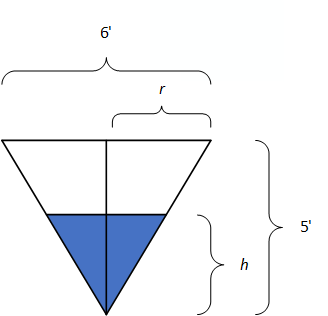
The triangle formed by the water is similar to the triangle formed by the funnel. This gives us the relationship
$$\frac{6}{5} = \frac{r}{h}$$ $$r = \frac{6h}{5}$$Substituting that into the volume equation gives us
$$V = \frac{1}{3}\left(\frac{6h}{5}\right)^2 h$$ $$V = \frac{12h^3}{25}$$ $$\frac{dV}{dt} = \frac{36h^2}{25} \frac{dh}{dt}$$ $$0.3 = \frac{36\cdot 2^2}{25} \frac{dh}{dt}$$ $$\frac{dh}{dt} = \frac{25 \cdot 0.3}{36\cdot 2^2} \approx 0.0521 \text{ in/sec. }$$A pump is removing water from a cylindrical storage tank at a rate of 4 liters per second. How fast is the height changing if the radius of the tank is 10'?
Beware the units. Since the height is in feet and the change in height will need to be in a linear units (presumably feet) per second. To make this happen, you'll need to convert the liters to a compatable foot-based volume measurement.
A pump is removing water from a cylindrical storage tank at a rate of 4 liters per second. How fast is the height changing if the radius of the tank is 10'?
The volume of a cylinder is given by
$$V = \pi r^2h$$ $$V = \pi (10)^2h$$ $$V = 100\pi h$$ $$\frac{dV}{dt} = 100\pi\frac{dh}{dt}$$At this point, we have a units issue. Since the height is in feet, we need to conver the 4 liters per second to cubic feet per second. There are 0.0353147 cubic feet per liter which means 4 liters per second is equivalent to $0.0353147 \text{ liters per second} cdot 4 = 0.141259 \text{ cu. ft. per second}$. Substituting that into our equation gives us
$$0.141259 = 100\pi\frac{dh}{dt}$$ $$\frac{dh}{dt} = \frac{0.14259}{100\pi} = 0.000454 \text{ feet/sec}$$A 30' ladder is propped against a building. The ladder starts to slip. If the bottom is moving away from the wall at a rate of 2 feet per second, how fast is angle formed by the angle and the ground changing when the ladder is 10' from the wall?
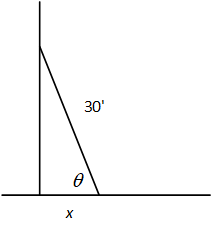
You can see the relationship in the diagram to the right. That gives us the equation
$$\cos \theta = \frac{x}{30}$$ $$-\sin \theta \frac{d\theta}{dt} = \frac{1}{30} \frac{dx}{dt}$$When $x = 10$, the end of the ladder against the wall is $$\sqrt{30^2 - 10^2} = \sqrt{800} = 20\sqrt{2}$$ so $\sin \theta = \frac{20\sqrt{2}}{30} = \frac{2\sqrt{2}}{3}$. Substituting that value and the values from the question into our formula gives us
$$-\frac{2\sqrt{2}}{3} \frac{d\theta}{dt} = \frac{1}{30} 2$$ $$-\frac{2\sqrt{2}}{3} \frac{d\theta}{dt} = \frac{1}{15}$$ $$ \frac{d\theta}{dt} = -\frac{1}{15} \cdot \frac{3}{2\sqrt{2}}$$ $$ \frac{d\theta}{dt} = -\frac{1}{10\sqrt{2}} = -\frac{\sqrt{2}}{20} \text{ rad/sec.}$$