


Exercises
 : shows the complete answer. : shows the complete answer. |  : gives a hint : gives a hint |
 : plays a video solution : plays a video solution |  : shows just the final answer : shows just the final answer |
 : these are important examples that illustrate new concepts, you should be sure to review the solutions to these questions : these are important examples that illustrate new concepts, you should be sure to review the solutions to these questions | |
Exercises
Identify the regions where the following graphs are concave up versus concave down and their inflection points if they have any.
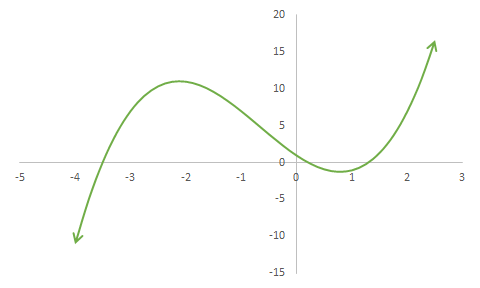
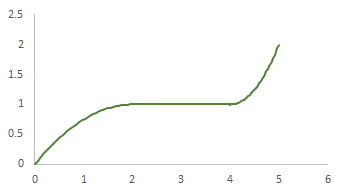
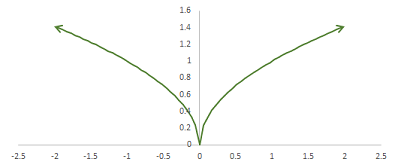
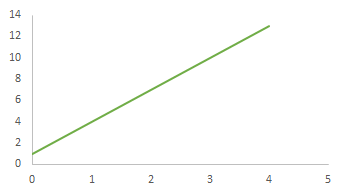
Determine the local extrema of the following functions and their inflection points then sketch their graphs. Use all the relevant steps of the graphing procedure discussed in the lectures.
|
|
|
|
|
|
|
|
|
|
|
|
|
|
|
|
|
|
|
|
|
|
|
|
Explorations
- What conclusion can you draw about a continuous function whose continuous second derivative is never 0?
- Does your conclusion from the previous question still have to hold if the second derivative is not continuous?
- What can you say about the inflection points of the general quadratic equation $f(x) = ax^2 + bx + c$?
- What can you say about the inflection points of the general cubic equation $f(x) = ax^3 + bx^2 + cx + d$?
Discuss how the graphs of the following functions change as $c$ changes, e.g. for how do the maximum/minimum values and inflection points change as $c$ changes? What are the transition points?
|
|
|
Icons courtesy of icons8.com
Determine the local extrema of the function $f(x) = x^3 - 4x - 1$ and its inflection points then sketch its graphs. Use all the relevant steps of the graphing procedure discussed in the lectures.
The function is defined everywhere.
It has no asymptotes.
It's first derivative is
$$f'(x) = 3x^2 - 4$$$f'(x) = 0$ when $x = \pm\frac{2}{\sqrt 3} \aprox \pm 1.15
The second derivative is
$$f''(x) = 6x$$$f''\left(\frac{2}{\sqrt 3}\right) = \frac{2}{\sqrt 3} > 0$ and so $x=\frac{2}{\sqrt 3}$ is a local minimum.
$f''\left(-\frac{2}{\sqrt 3}\right) = -\frac{2}{\sqrt 3} < 0$ and so $x=-\frac{2}{\sqrt 3}$ is a local maximum.
Finally, the second derivative is positive when $x > 0$ so it's concave up on the interval and it's negative when $x < 0$ so it's concave down on that side of the origin.
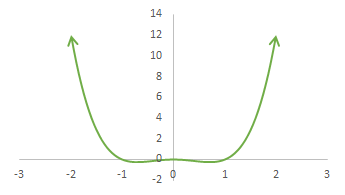
Determine the local extrema of the function $f(x) = x + \sqrt x$ and its inflection points then sketch its graphs. Use all the relevant steps of the graphing procedure discussed in the lectures.
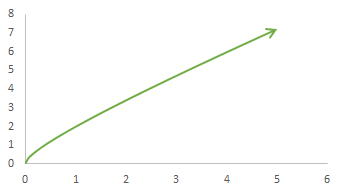
Domain: $[0, \infty)$
Asymptotes: none
$$f'(x) = 1 + x^{-1/2}$$Local Extrema: Min at $(0, 0)$, no rel./abs. max
$$f''(x) = -\frac{1}{2}x^{-3/2}$$Concavity: concave up everywhere it's defined
What conclusion can you draw about a continuous function whose continuous second derivative is never 0?
Does the function have any inflection points? What does that tell you about the concavity?
What conclusion can you draw about a continuous function whose continuous second derivative is never 0?
If the second derivative is never 0 then the function doesn't have any potential inflection points so its concavity never changes. It's either always concave up or always concave down.
Put another way, if the function is continuous and its second derivative is never 0 then the Intermediate Value Theorem says its either always positive or always negative. That means it's always either concave or up or concave down.
Does your conclusion from the previous question still have to hold if the second derivative is not continuous?
In this case, the conclusion is no longer true because the function could be positive (or negative) on one side of the discontinuity and the opposite sign on the other.
What can you say about the inflection points of the general quadratic equation $f(x) = ax^2 + bx + c$?
The second derivative is constant, $f''(x) = 2a$, so the function doesn't have any inflection points.
What can you say about the inflection points of the general cubic equation $f(x) = ax^3 + bx^2 + cx + d$?
The second derivative of this funciton is
$$f'(x) = 3ax^2 + 2bx + c$$ $$f''(x) = 6ax + 2b$$So the function has an inflection point at
$$6ax + 2b = 0$$ $$6ax = -2b$$ $$ax = -\frac{b}{3a}$$The second derivative does change sign going through that point so it is an inflection point.
Discuss how the graphs of $f(x) = \ln(x^2 + c)$ changes as $c$ changes, e.g. for how do the maximum/minimum values and inflection points change as $c$ changes? What are the transition points?
Find the first and second derivatives then consider three cases: $x < 0$, $x = 0$ and $x > 0$.
Discuss how the graphs of $f(x) = \ln(x^2 + c)$ changes as $c$ changes, e.g. for how do the maximum/minimum values and inflection points change as $c$ changes? What are the transition points?
To talk about the local extrema, we need the first derivative.
$$f'(x) = \frac{2x}{x^2+c}$$Case 1: $c > 0$
In this case, the domain of the original function is all real numbers and the denominator is never equal to 0. This means that the only possible critical value occurs at $x=0$ where the numerator equals 0. The derivative will change sign going through this point so this will be an local extremum.
Case 2: $c = 0$
In this scenario, the original function is just $f(x) = \ln x^2 = 2\ln x$. The derivate becomes
$$f'(x) = \frac{2x}{x^2} = \frac{2}{x}$$The denominator is 0 at $x = 0$ but the function isn't defined there so it can't be an critical point.
Case 3: $c < 0$
In this case, the domain are all values where
$$x^2 + c > 0$$which are the values $|x| > \sqrt{c}$. The numerator of the derivative is still equal to 0 at $x = 0$ and the denominator is 0 at $x = \pm\sqrt{c}$. The function is undefined at all of those points so there are no extrema in this case either.
To talk about inflection points, we need the second derivative.
$$f'(x) = \frac{2x}{x^2+c}$$ $$f''(x) = \frac{(x^2 + c) \cdot 2 - 2x \cdot 2x}{(x^2 + c)^2}$$ $$f''(x) = \frac{2x^2 + 2c - 4x^2}{(x^2 + c)^2}$$ $$f''(x) = \frac{2(c - x^2)}{(x^2 + c)^2}$$The denominator is always positive so we can't get any inflection points from it. The numerator gives us three cases.
Case 1: $c > 0$
In this case, the numerator is equal to 0 when $x=\pm\sqrt{c}$. It will change sign going through those points so the function will have inflrection points there.
Case 2: $c = 0$
This makes $f''(x) = -2x^2/x^4 = -2/x^2$. This is always negative so there can't be any inflection points.
Case 3: $c < 0$
Let $b = -c$. This makes the derivative
$$f''(x) = \frac{-2(b + x^2)}{(x^2 + c)^2}$$In this case, the numerator is also always positive which means the sign of the second derivative never changes and there are no inflection points.
Discuss how the graphs of $f(x) = e^{x^2 + c}$ changes as $c$ changes, e.g. for how do the maximum/minimum values and inflection points change as $c$ changes? What are the transition points?
$$f'(x) = 2xe^{x^2 + c}$$
Regardless of the value of $c$, this is only 0 when $x=0$ so the value of $c$ doesn't effect whether or not the function has a local maximum or minimum.
$$f''(x) = 2e^{x^2 + c} + 2x \cdot 2xe^{x^2 + c}$$ $$f''(x) = 2e^{x^2 + c}(1 + 2x^2)$$The roots of this function also don't depend on $c$ so it also doesn't affect whether or not the function has inflection points.
