


Exercises
 : shows the complete answer. : shows the complete answer. |  : gives a hint : gives a hint |
 : plays a video solution : plays a video solution |  : shows just the final answer : shows just the final answer |
 : these are important examples that illustrate new concepts, you should be sure to review the solutions to these questions : these are important examples that illustrate new concepts, you should be sure to review the solutions to these questions | |
Moving Objects
|
|
|
|
|
|
 The position of a particle is given by $s = x^3$. Find the average velocity of the particle on the interval $[0, 2]$. Is there a point on that interval where the instantaneous velocity of the particle is equal to the average velocity?
The given function's describe the position of an object at time $t$. Find a function for the object's velocity, graph both functions and discuss the relationship between the graphs. When is the object moving forward vs. backwards? When is it stopped?
|
|
|
|
|
|
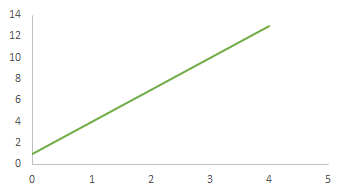
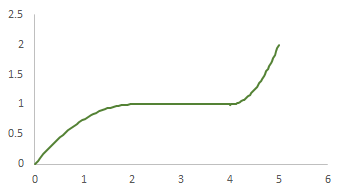
The graphs below show the position (on the y-axis) of an object over time (on the x-axis). Describe the motion of the objects and their velocities.
Determine if the following statements are true or false.
- If an object's acceleration is 0 then its velocity is 0.
- If an object's velocity is 0 then its position is constant.
- If an object's position is constant then its velocity is 0.
- If an object's position is constant then its acceleration is 0.
Marginal Change
|
|
|
|
|
|
Elasticity
|
|
|
|
|
|
|
Icons courtesy of icons8.com
A ball is thrown in the air with an initial velocity of 30 ft/s. If it's position is given by $y=-16t^2 + 30t$ find the its velocity at $t=3$ seconds. At what time is the velocity 0?
The velocity is 0 when
$$v(t) = 0 = -32t + 30$$ $$t = 30/32 = 0.9375$$So the velocity is 0 after 0.9375 seconds. This is the point where the object reaches its maximum height and starts falling back down.
The velocity function is the derivative of the distance function which makes it
$$v=\frac{dy}{dt} = -32t + 30$$At $t=3$ seconds, the velocity will be
$$v(3) = -32 * 3 + 30 = -63$$Since we're talking about an object moving vertically, the negative value indicates that the object is moving down at that time.
The height of a projectile in meters is given by $y=-4.9t^2 + 40t + 100$ where $t$ is in seconds. What are the units of the three coefficients? Rewrite the equation so that it uses miles and hours then find determine the object's acceleration in those units.
Each of the three individual terms have to have units that simplify to just feet.
The height of a projectile in meters is given by $y=-4.9t^2 + 40t + 100$ where $t$ is in seconds. What are the units of the three coefficients? Rewrite the equation so that it uses miles and hours then find determine the object's acceleration in those units.
All three terms have to individually simplify to feet. In the first term, the $t^2$ term will be seconds squared so the -4.9's units have to be "meters per second squared". (Notice that that's the unit for acceleration.)
In the second term, the $t$ will be in seconds so the 40 has to be meters per second.
And, finally, the 100 will just be in feet.
For the equation to be in miles per hour, we need to convert each of those three units into miles per hour squared, miles per hour and miles.
-4.9 meters per second squared = -39329 miles per hour squared
40 meters per second = 89.5 miles per hour
100 meters = 0.0621 miles
So the new version of the equation is
$$y=-39239t^2 + 89.5t + 0.0621$$We can find the acceleration by differentiating twice.
$$v = \frac{dy}{dt} = -78478t + 89.5$$ $$a= \frac{dv}{dt} = -78478$$The position of a particle is given by $s = x^3$. Find the average velocity of the particle on the interval $[0, 2]$. Is there a point on that interval where the instantaneous velocity of the particle is equal to the average velocity?
The average velocity is
$$\begin{aligned} \bar{v} &= \frac{s(2) - s(0)}{2 - 0} \\ &= \frac{8 - 0}{2 - 0} \\ &= 4 \end{aligned}$$The instantaneous velocity is given by
$$v = \frac{ds}{dt} = 3x^2$$So the velocity is equal to 4 when
$$4 = 3x^2$$ $$x = \pm \sqrt{\frac{4}{3}}$$ $$x = \pm \frac{2\sqrt{3}}{3}$$Since we're only interested in values on the interval $[0, 2]$, the instantaneous velocity is equal to the average velocity at $x=\frac{2\sqrt{3}}{3}$.
The existence of this value isn't a coincidence. We'll see later in this chapter that, assuming the function is continuous, there will always be a point where the two velocities are equal.
The position of a particle is given by the function $s=\cos(2t)$. At what times is the object not moving?
The object isn't moving when it's velocity is 0.
The position of a particle is given by the function $s=\cos(2t)$. At what times is the object not moving?
The object isn't moving when it's velocity is 0.
$$v = \frac{ds}{dt} = -2\sin(2t)$$ $$-2\sin(2t) = 0$$ $$\sin(2t) = 0$$ $$2t = k\pi, k\in\mathbb{Z}$$ $$t = \frac{k\pi}{2}, k\in\mathbb{Z}$$The function $s(x) = x^3+2$ describes the position of an object at time $t$. Find a function for the object's velocity, graph both functions and discuss the relationship between the graphs. When is the object moving forward vs. backwards? When is it stopped?
$$v(x) = s'(x) = 3x^2$$
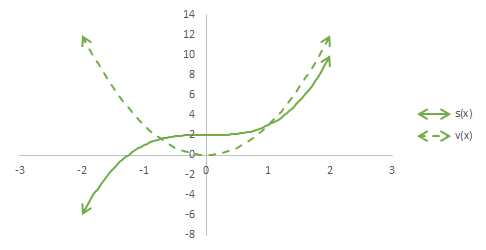
Notice that the the velocity function is always positive which tells us that the object is always moving forward or, in other words, the value of it's position is always increasing.
The velocity is equal to 0 at $t=0$ so the object comes to a stop at that time but it immediately starts moving again and in the same direction.
The function $s(x) = \ln(x)$ describes the position of an object at time $t$. Find a function for the object's velocity, graph both functions and discuss the relationship between the graphs. When is the object moving forward vs. backwards? When is it stopped?
$$v(x) = \frac{1}{x}$$
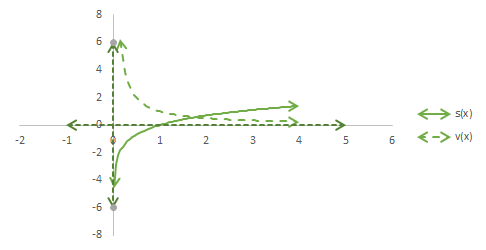
The velocity function never crosses the x-axis, i.e. it never equals 0, so the object never stops moving.
As $x$ gets close to 0, the velocity function is unbounded which means the function is moving faster and faster which you can see happening as it drops off to negative infinity.
On the other hand, as $x$ goes to infinity, the velocity function goes to 0 which means the object's motion is slowing down (although it never actually stops). You can see that in the way the position graph is leveling off and increasing more slowly as $x$ gets large.
The graph below shows the position of an object over time. Describe the motion of the object and its velocity.
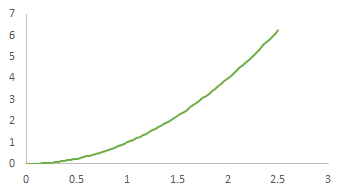
It looks like the tangent line at the origin is horizontal, i.e. its slope is 0, which means the object starts at rest then picks up speed as it goes along. If you visualize tangent lines starting from the origin and going to the right, you'll see that they get progressively steeper which means that the velocity is increasing so the object must be accelerating.
The graph below shows the position of an object over time. Describe the motion of the object and its velocity.
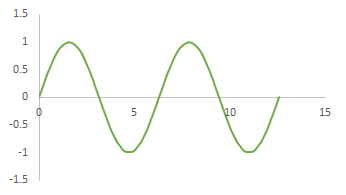
This object is going back and forth from +1 to -1. Starting from the origin it slows down as it gets to the maximum value at $y=1$ where it stops (so it's velocity will be 0), turns around and accelerates back the other way. The process repeats as the object approachs $y=-1$, i.e. it slows down, stops then turns around.
Is it true that if an object's acceleration is 0 then its velocity is 0?
This is false. Consider the case where $v(t) = 5$. The velocity clearly isn't 0 but $a(t) = v'(t) = 0$.
Is it true that if an object's position is constant then its velocity is 0?
This is true. If $s(t) = c$, i.e. it isn't moving, then $v(t) = s'(t) = 0$.
The revenue generated from selling $x$ units is given by the function $R(x) =x^3 - 2x$. What's the marginal revenue of the 100th unit?
The marginal revenue is given by
$$R'(x) = 3x^2 - 2$$so the margin revenue of the 100th item sold is
$$R'(100) = 3(100)^2 - 2 = $29,998$$An analyst has determined that the cost of producing $x$ units of a product is $C(x) = 22x + 1000$ and the corresponding revenue is $R(x) = 25x - \frac{x^2}{1000}$. Given that profit is the difference between revenue and cost, find a formula for marginal profit.
$$\begin{aligned} P(x) &= R(x) - C(x) \\ &= 25x - \frac{x^2}{1000} - (22x + 1000) \\ &= 25x - \frac{x^2}{1000} - 22x - 1000 \\ &= 23x - \frac{x^2}{1000} - 1000 \end{aligned}$$
This makes the marginal profit
$$\begin{aligned} P'(x) &= 23 - \frac{2x}{1000} - 0 \\ &= 23 - \frac{x}{500} \end{aligned}$$This equals 0 when
$$23 - \frac{x}{500} = 0$$ $$\frac{x}{500} = 23$$ $$x = 11,500\text{ units}$$This is the point where the profit earned by selling an additional item starts to decrease. It hasn't become negative yet but it's turned around and is heading in that direction. From an economics perspective, this reflects the idea that, as the number of items produced increases, the market becomes saturated, fewer items are purchased and the net revenue will decrease.
If $C(x)$ is the cost of producing $x$ units then $\bar{C}(x) = \frac{C(x)}{x}$ is the average cost. If the cost of producing a function $C(x) = \frac{x^2}{1000} + 25x + 1000$, find formulas for the average cost and the marginal average cost.
$$\begin{aligned} \bar{C}(x) &= \frac{C(x)}{x} \\ &= \frac{\frac{x^2}{1000} + 25x + 1000}{x} \\ &= \frac{x}{1000} + 25 + \frac{1000}{x} \end{aligned}$$
The marginal average cost is the derivative of this function.
$$\bar{C}'(x) = \frac{1}{1000} - \frac{1000}{x^2}$$The demand for airline travel is given by $q=125.2 - 13.6p$. Find the elasticity when the price is $252. Is the demand elastic or inelastic at that price?
$$\begin{aligned} E &= \left|\frac{p}{q}\frac{dq}{dp}\right| \\ &= \left|\frac{p}{125.2-13.6p} \cdot (-13.6)\right| \\ &= \left|\frac{13.6p}{125.2-13.6p}\right| \end{aligned}$$
So at a price of $p=252$, the elasticity is
$$E(252) = \left|\frac{13.6 \cdot 252}{125.2-13.6 \cdot 252}\right| = 1.037$$Since this is greater than 1 the demand is elastic but barely.
The demand for fuel coal is found to be $q=\frac{1531}{p^{0.315}}$. For what prices is the demand elastic?
The elasticity is given by
$$\begin{aligned} E &= \left|\frac{p}{q}\frac{dq}{dp}\right| \\ &= \left|\frac{p}{\frac{1531}{p^{0.315}}} \frac{d}{dp} (1531 \cdot p^{-0.315})\right| \\ &= \left|\frac{p^{1.315}}{1531} \cdot 1531 \cdot (-0.315) p^{-1.315})\right| \\ &= 0.315 \end{aligned}$$This is less than 1 for all prices so the demand is never elastic.
Compute the elasticity of the exponential demand function, $q=ae^{-bp}$, where $a$ and $b$ are positive constants. For what values of $p$ is the function elastic? For what values is it inelastic?
$$\begin{aligned} E &= \left|\frac{p}{q}\frac{dq}{dp}\right| \\ &= \left|\frac{p}{ae^{-bp}} \cdot (-b)ae^{-bp}\right| \\ &= \left|-bp\right| \\ &= bp \end{aligned}$$
We can drop the absolute value since $b$ is positive and we can assume that the price won't be negative. The demand is inelastic when
$$bp < 1$$ $$p < \frac{1}{b}$$and inelastic whtn $p > \frac{1}{b}$.
