


Exercises
 : shows the complete answer. |  : gives a hint |
 : plays a video solution |  : shows just the final answer |
 : these are important examples that illustrate new concepts, you should be sure to review the solutions to these questions | |
Exercises
Find the derivatives of the following functions.
|
|
|
|
|
|
|
|
|
|
|
|
Find $y'$ for the following relations.
|
|
|
|
|
|
 $\sec^{-1}\left(\frac{x}{y}\right)=1$
For the given functions, find the derivatives of their inverses at the given points.
|
|
|
Explorations
- Using a graphing program, e.g. desmos.com, to graph the relation $\tan^{-1}(xy)=xy$. How does this compare to the derivative you found for this relation in a question earlier on this page? (You can try graphing the function by hand but it's a fairly unusual result.)
- Derive the formula for the derivative of $f(x) = \cos^{-1} x$.
- Derive the formula for the derivative of $f(x) = \csc^{-1} x$.
- Derive the formula for the derivative of $y = \cot^{-1} x$ by differentiating both sides of $\cot y = x$.
- Use the trigonometric identity $\sec^{-1}x= \frac{\pi}{2} - \csc^{-1} x$ to derive a formula for the derivative of $\sec^{-1}x$ using the derivative of $\csc^{-1}x$.
- Simplify $f(x) = \cos(\sin^{-1} x)$ trigonometrically then find the derivatives of both versions of the functions and confirm that both methods give the same result.
Icons courtesy of icons8.com
Find the derivative of $y=\tan^{-1}(x^2+1)$
Let $u=x^2+1$ then we can apply the Chain Rule:
$$y=\tan^{-1}(u)$$ $$y'=\frac{1}{1+u^2}\frac{du}{dx}$$ $$y'=\frac{1}{1+u^2}\cdot 2x$$ $$y'=\frac{1}{1+(x^2+1)^2}\cdot 2x$$ $$y'=\frac{2x}{1+(x^2+1)^2}$$ $$y'=\frac{2x}{x^4+2x^2+2}$$Find the derivative of $y=x\sin^{-1}\left(\frac{1}{x}\right)$.
First use the Product Rule.
$$y=x\sin^{-1}\left(\frac{1}{x}\right)$$ $$y=x \frac{d}{dx}\sin^{-1}\left(\frac{1}{x}\right) + \frac{d}{dx}x \cdot \sin^{-1}\left(\frac{1}{x}\right)$$ $$y=x \frac{d}{dx}\sin^{-1}\left(\frac{1}{x}\right) + \sin^{-1}\left(\frac{1}{x}\right)$$Now let $u=\frac{1}{x}$ so $\frac{du}{dx} = -\frac{1}{x^2}$ and apply the Chain Rule.
$$y=x \frac{d}{dx}\sin^{-1} u + \sin^{-1}\left(\frac{1}{x}\right)$$ $$y=x \frac{1}{\sqrt{1-u^2}}\frac{du}{dx} + \sin^{-1}\left(\frac{1}{x}\right)$$ $$y=\frac{x}{\sqrt{1-u^2}}\left(-\frac{1}{x^2}\right) + \sin^{-1}\left(\frac{1}{x}\right)$$ $$y=-\frac{1}{x\sqrt{1-u^2}} + \sin^{-1}\left(\frac{1}{x}\right)$$ $$y=-\frac{1}{x\sqrt{1-(1/x)^2}} + \sin^{-1}\left(\frac{1}{x}\right)$$ $$y=-\frac{1}{x\sqrt{\frac{x^2-1}{x^2}}} + \sin^{-1}\left(\frac{1}{x}\right)$$ $$y=-\frac{1}{\sqrt{x^2-1}} + \sin^{-1}\left(\frac{1}{x}\right)$$Find the derivative of $y=\arccos(\ln(x))$.
Let $u=\ln x$ and $\frac{du}{dx}=\frac{1}{x}$ and apply the Chain Rule.
$$y=\arccos(\ln(x))$$ $$y=\arccos(u)$$ $$y'=-\frac{1}{\sqrt{1-u^2}}\frac{du}{dx}$$ $$y'=-\frac{1}{\sqrt{1-\ln^2 x}}\frac{1}{x}$$ $$y'=-\frac{1}{x\sqrt{1-\ln^2 x}}$$Find the derivative of $y=\ln\left(\arccos(x)\right)$.
Let $u=\arccos x$ and $\frac{du}{dx}=-\frac{1}{\sqrt{1-x^2}}$ and apply the Chain Rule.
$$y=\ln\left(\arccos(x)\right)$$ $$y'=\frac{1}{\arccos x} \cdot \frac{du}{dx}$$ $$y'=\frac{1}{\arccos x} \cdot \left(-\frac{1}{\sqrt{1-x^2}}\right)$$ $$y'=-\frac{1}{\sqrt{1-x^2}\arccos x}$$Find the derivative of $y=\arcsin\left(\frac{x+1}{x-1}\right)$.
Let $u=\frac{x+1}{x-1}$ and
$$\frac{du}{dx} = \frac{(x-1) \cdot 1 - (x+1) \cdot 1}{(x-1)^2} = -\frac{2}{(x-1)^2} $$Then the Chain Rule gives us
$$y = \arcsin\left(\frac{x+1}{x-1}\right)$$ $$y = \arcsin u$$ $$y' = \frac{1}{\sqrt{1-u^2}} \frac{du}{dx}$$ $$y' = \frac{1}{\sqrt{1-u^2}} \cdot \left(-\frac{2}{(x-1)^2}\right)$$ $$y' = \frac{1}{\sqrt{1-\left(\frac{x+1}{x-1}\right)^2}} \cdot \left(-\frac{2}{(x-1)^2}\right)$$ $$y' = \frac{1}{\sqrt{\left(\frac{(x-1)^2-(x+1)^2}{x-1}\right)^2}} \cdot \left(-\frac{2}{(x-1)^2}\right)$$ $$y' = \frac{1}{\sqrt{\left(\frac{-4x}{x-1}\right)^2}} \cdot \left(-\frac{2}{(x-1)^2}\right)$$ $$y' = \frac{1}{\frac{4x}{x-1}} \cdot \left(-\frac{2}{(x-1)^2}\right)$$ $$y' = \frac{x-1}{4x} \cdot \left(-\frac{2}{(x-1)^2}\right)$$ $$y' = -\frac{1}{2x(x-1)}$$ $$y' = -\frac{1}{2x^2-2x}$$Find the derivative of $y=\cos^{-1}(\cos(x) + 1)$.
Let $u=\cos(x) + 1$ and $\frac{du}{dx} = -\ sin x$. Then the Chain Rule gives us
$$y=\cos^{-1}(\cos(x) + 1)$$ $$y=\cos^{-1} u$$ $$y' = -\frac{1}{\sqrt{1-u^2}} \cdot \frac{du}{dx}$$ $$y' = -\frac{1}{\sqrt{1-(\cos(x) + 1)^2}} \cdot (-\sin x)$$ $$y' = \frac{1}{\sqrt{1-\cos^2(x) - 2\cos x - 1}} \cdot (\sin x)$$ $$y' = \frac{\sin x}{\sqrt{-\cos^2(x) - 2\cos x}}$$Find $y'$ for the relation $\tan^{-1}(xy)=xy$.
$$\tan^{-1}(xy)=xy$$ $$\frac{1}{1+(xy)^2} \frac{d}{dx}(xy) = xy' + 1y$$ $$\frac{1}{1+(xy)^2} (xy' + y) = xy' + y$$ $$\frac{xy' + y}{1+(xy)^2} = xy' + y$$ $$\frac{xy'}{1+(xy)^2} + \frac{y}{1+(xy)^2} = xy' + y$$ $$\frac{xy'}{1+(xy)^2} - xy' = y - \frac{y}{1+(xy)^2}$$ $$y'\left(\frac{x}{1+(xy)^2} - x\right) = \frac{y(1+(xy)^2)}{1+(xy)^2} - \frac{y}{1+(xy)^2}$$ $$y'\frac{x-x(1+(xy)^2)}{1+(xy)^2} = \frac{y+y(xy)^2-y}{1+(xy)^2}$$ $$y'\frac{x(xy)^2)}{1+(xy)^2} = \frac{y(xy)^2}{1+(xy)^2}$$ $$y'(x^3y^2)=x^2y^3$$ $$y'=\frac{y}{x}$$Find $y'$ for the relation $\sec^{-1}\left(\frac{x}{y}\right)=1$.
$$\sec^{-1}\left(\frac{x}{y}\right)=1$$ $$\frac{1}{\frac{x}{y}\sqrt{\left(\frac{x}{y}\right)^2-1}}\frac{d}{dx}\left(\frac{x}{y}\right)=0$$ $$\frac{1}{\frac{x}{y}\sqrt{\left(\frac{x}{y}\right)^2-1}}\frac{xy'-1\cdot y}{y^2}=0$$ $$\frac{xy'-1\cdot y}{xy\sqrt{\left(\frac{x}{y}\right)^2-1}}=0$$ $$xy'-y=0$$ $$y' = \frac{y}{x}$$We can be a little casual sometimes about elminating things when we're solving these equations. For example, when I eliminated $xy\sqrt{\left(\frac{x}{y}\right)^2-1}$ from the denominator. It's okay to do that as long as that expression is never equal to 0. If there are places where it is equal to 0 then the derivative will actually be undefined there. A key point to keep in mind here is that you can't pick any values that you like for $x$ and $y$ here. THe only points we care about are ones that satisfy the original equation. To see that it was okay to do what I did, look at the equation:
$$xy\sqrt{\left(\frac{x}{y}\right)^2-1} = 0$$That equation has three possible solutions:
- $x = 0$ which isn't possible because $\arcsin(0/y) = \arcsin(0)$ which is undefined for all values of $y$.
- $y=0$ which also isn't possible because $arcsin(x/0)$ is undefined for all values of $x$.
- $x/y-1=0$ which only occurs when $x=y$. Whenever $x=y$, the original equation becomes $\arcsin(1) = 1$ which is false.
Since there were no values of $x$ and $y$ that made the expression I eliminated equal to 0, it was okay to multiply both sides by it.
Find $y'$ for the relation $\left(\frac{\tan^{-1} x}{\tan^{-1}y}\right)=x$.
$$\left(\frac{\tan^{-1} x}{\tan^{-1}y}\right)=x$$ $$\frac{\tan^{-1} y \cdot \frac{d}{dx}\tan^{-1} x - \tan^{-1} x \cdot \frac{d}{dx}\tan^{-1} y}{(\tan^{-1} y)^2} = 1$$ $$\frac{\tan^{-1} y \cdot \frac{1}{1+x^2} - \tan^{-1} x \cdot \frac{1}{1+y^2} \cdot y'}{(\tan^{-1} y)^2} = 1$$ $$\frac{\frac{\tan^{-1} y}{1+x^2} - y'\frac{\tan^{-1} x}{1+y^2}}{(\tan^{-1} y)^2} = 1$$ $$\frac{\tan^{-1} y}{1+x^2} - y'\frac{\tan^{-1} x}{1+y^2} = (\tan^{-1} y)^2$$ $$y'\frac{\tan^{-1} x}{1+y^2} = -(\tan^{-1} y)^2 + \frac{\tan^{-1} y}{1+x^2}$$ $$y'\frac{\tan^{-1} x}{1+y^2} = \frac{\tan^{-1} y-(\tan^{-1} y)^2(1+x^2)}{1+x^2}$$ $$y' = \frac{(1+y^2)(\tan^{-1} y-(\tan^{-1} y)^2(1+x^2))}{(1+x^2)\tan^{-1} x}$$You could arguably simlify this further by multiplying out the numerator but I don't think there's a lot to be gained by it.
Find the derivative of the inverse of $f(x) = x\cos x$ at $x = 0 = f(\pi/2)$.
Start by using the formula for the derivative of the inverse of a function:
$$\frac{d}{dx}f^{-1}(x) = \frac{1}{f'(f^{-1}(x))}$$Then substitute 0 for $x$. Remember that if the point $(x, y)$ satisfies the original function then the point $(y, x)$ satisfies the inverse.
Find the derivative of the inverse of $f(x) = x\cos x$ at $x = 0 = f(\pi/2)$.
$$\frac{d}{dx}f^{-1}(x) = \frac{1}{f'(f^{-1}(x))}$$ $$\frac{d}{dx}f^{-1}(0) = \frac{1}{f'(f^{-1}(0))}$$ $$\frac{d}{dx}f^{-1}(0) = \frac{1}{f'(\pi/2)}$$
Since $f'(x) = \cos x - x\sin x$ we have $f'(\pi/2) = \cos (\pi/2) - \frac{\pi}{2} \cdot \sin (\pi/2)=- \frac{\pi}{2}$. This leaves us with
$$\frac{d}{dx}f^{-1}(0) = \frac{1}{-\frac{\pi}{2}} = -\frac{2}{\pi}$$Find the derivative of the inverse of $f(x) = x^2 \ln x$ at $x = e^2 = f(e)$.
$$\frac{d}{dx}f^{-1}(x) = \frac{1}{f'(f^{-1}(x))}$$ $$\frac{d}{dx}f^{-1}(e^2) = \frac{1}{f'(f^{-1}(e^2))}$$ $$\frac{d}{dx}f^{-1}(e^2) = \frac{1}{f'(e)}$$
Since $f'(x) = x + 2x\ln x$ we have $f'(e) = e + 2e\ln e = 3e$. This leaves us with
$$\frac{d}{dx}f^{-1}(e^2) = \frac{1}{3e}$$Using a graphing program, e.g. desmos.com, to graph the relation $\tan^{-1}(xy)=xy$. How does this compare to the derivative you found for this relation in a question earlier on this page? (You can try graphing the function by hand but it's a fairly unusual result.)
First, recall that, for this relation, $y'=\frac{y}{x}$. Your graph should be just two lines - the x- and y-axes.
Points on the y-axis have the form $(0,y)$. For those values, our formula for $y'$ says that the slope of the tangent line is undefined which is what we would expect for a vertical line like the y-axis.
Points on the x-axis, on the other hand, have the form $(x, 0)$. For those values, our formula says that $y' = \frac{0}{x}$ which is equal to 0 which is consistent with what we would expect for a horizontal line like the x-axis.
The origin, $(0, 0)$ is an exception to the previous paragraph but, at that point, we would have $y' = \frac{0}{0}$ which is going to be undefined which is also what we would expect at a point where the graph makes a sharp angle.
Derive the formula for the derivative of $f(x) = \csc^{-1} x$
Let $g(x) = \csc x$ so $f(x) = g^{-1}(x)$. Then we have
$$\frac{d}{dx}g^{-1}(x) = \frac{1}{g'(g^{-1}(x))}$$ $$\frac{d}{dx}\csc^{-1}(x) = \frac{1}{-\csc(g^{-1}(x))\cot(g^{-1}(x))}$$ $$\frac{d}{dx}\csc^{-1}(x) = -\frac{1}{\csc(\csc^{-1} x)\cot(\csc^{-1} x)}$$ $$\frac{d}{dx}\csc^{-1}(x) = -\frac{1}{x\cot(\csc^{-1} x)}$$To simplify the $\cot(\csc^{-1} x)$ part, look at the following diagram. It was drawn so that the cosecant of the angle $\theta$ is $x$, i.e. $\csc^{-1} x = \theta$. The bottom side was filled in using the Pythagorean Theorem.
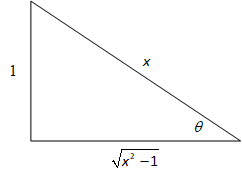
If we substitute that into our derivative equation, it becomes
$$\frac{d}{dx}\csc^{-1}(x) = -\frac{1}{x\cot(\theta)}$$ $$\frac{d}{dx}\csc^{-1}(x) = -\frac{1}{x\sqrt{x^2-1}}$$Derive the formula for the derivative of $y = \cot^{-1} x$ by differentiating both sides of $\cot y = x$.
$$\cot y = x$$ $$-\csc^2 y y' = 1$$ $$y' = -\frac{1}{\csc^2 y }$$
Going back to the original equation $y = \cot^{-1} x$, $y$ is an angle whose cotangent is $x$. This relationship is illustrated in the triangle below with the hypotenuse filled in using the Pythagorean Theorem.
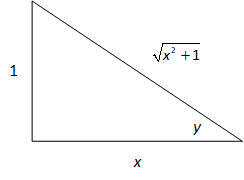
This means that $\csc y = \sqrt{x^2+1}$ which makes our derivative equation
$$y' = -\frac{1}{(\sqrt{x^2+1})^2 }$$ $$y' = -\frac{1}{x^2+1}$$Use the trigonometric identity $\sec^{-1}x= \frac{\pi}{2} - \csc^{-1} x$ to derive a formula for the derivative of $\sec^{-1}x$ using the derivative of $\csc^{-1}x$.
$$\sec^{-1}x= \frac{\pi}{2} - \csc^{-1} x$$ $$\frac{d}{dx}\sec^{-1}x= 0 - \left(-\frac{1}{x\sqrt{x^2-1}}\right)$$ $$\frac{d}{dx}\sec^{-1}x= \frac{1}{x\sqrt{x^2-1}}$$
Simplify $f(x) = \cos(\sin^{-1} x)$ trigonometrically then find the derivatives of both versions of the functions and confirm that both methods give the same result.
Applying the definition for the derivative of the inverse cosine gives us
$$f(x) = \cos(\sin^{-1} x)$$ $$f'(x) = -\sin(\sin^{-1} x)\frac{d}{dx}\sin^{-1} x$$ $$f'(x) = -x \cdot \frac{1}{\sqrt{1-x^2}}$$ $$f'(x) = -\frac{x}{\sqrt{1-x^2}}$$On the other hand, if let $\theta = \sin^{-1}x$ then $\sin \theta = x$ and the relationship is illustrated in the triangle below with the length of the bottom side filled in using the Pythagorean Theorem.
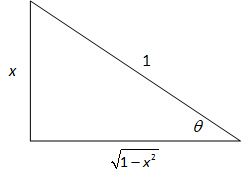
This makes our equation
$$f(x) = \cos(\sin^{-1} x) = \cos heta = \sqrt{1-x^2}$$so
$$\begin{aligned} f(x) &= (1-x^2)^{1/2} \\ &= \frac{1}{2}\cdot (1-x^2)^{-1/2} \frac{d}{dx}(1-x^2) \\ &= \frac{1}{2\sqrt{1-x^2}} \cdot (-2x) \\ &= -\frac{x}{\sqrt{1-x^2}} \end{aligned}$$