


Exercises
 : shows the complete answer. : shows the complete answer. |  : gives a hint : gives a hint |
 : plays a video solution : plays a video solution |  : shows just the final answer : shows just the final answer |
 : these are important examples that illustrate new concepts, you should be sure to review the solutions to these questions : these are important examples that illustrate new concepts, you should be sure to review the solutions to these questions | |
Exercises
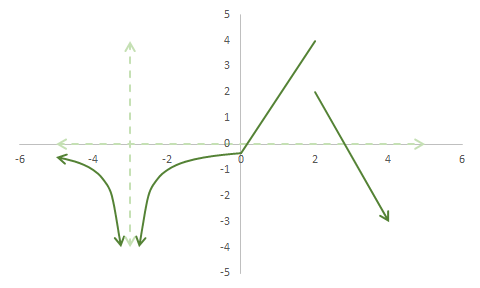
- Identify the points where the graph below is discontinuous and explain why.
- A company charges €20 per unit for a widget. They charge €2 per unit for shipping on orders of less than 10 units and €1 per unit on ordrs of more than 10 units. Give a piecewise function that describes the total cost of an item. Graph the function and determine where it's continuous.
- Referring to the scenario in the previous question, how does the situation change if the company charges a flat €20 shipping charge for orders over 10 units?
Sketch the graph of a function that meets the following requirements.
|
|
|
|
|
|
Use the properties of continuity discussed in the lectures to show that the following functions are continuous everywhere that they're defined.
|
|
|
|
|
|
Explain why the following functions are discontinuous at the given values.
|
|
|
|
|
|
|
|
For each of the following functions, find values of a and b that make the function continuous.
|
|
|
|
|
|
Use the Intermediate Value to either confirm that the function has a root on the given interval or to find an interval on which the function has a root if none is given.
|
|
|
|
|
|
Explorations
- Show that $\lim\limits_{x\to\infty}f(x) = \lim\limits_{x\to0^+}f\left(\frac{1}{x}\right)$.
- Show that $\lim\limits_{x\to-\infty}f(x) = \lim\limits_{x\to0^-}f\left(\frac{1}{x}\right)$.
- Explain how you would use continuity to evaluate $\lim\limits_{x\to-\pi}(\cos(2x + \sin(x))$.
- $f(x)=\cos(x)$ has a solution on the interval $[-\pi/4, \pi/4]$ even though $\cos(-\pi/4)$ and $\cos(\pi/4)$ are both greater than 0. Explain how this is consistent with the Intermediate Value Theorem.
- Suppose that f is a defined on the interval $\left( a, b\right)$ and is continuous at a point c where $f(c)\ne0$. Show that there exists an interval $\left(c-\delta, c+\delta\right)$ where f has the same sign as $f(c)$.
- Show that the absolute value function is continuous everywhere.
- Show that $g(x) = |f(x)|$ is continuous wherever f is continuous.
- Show that the function $f(x) = \begin{cases}0, x \text{ is rational}\\1, x \text{ is irrational}\end{cases}$ is discontinuous everywhere. (Hint: Every nonempty interval contains both irrational numbers and rational numbers.)
- Show that if f is continuous on [0, 1] and $0 \le f(x) \le 1$ then there exists a point c between 0 and 1 such that $f(c) = c$, i.e. f has a fixed point on [0, 1].
- Show that if f is continuous on [a, b] and $a \le f(x) \le b$ then there exists a point on c between a and b such that $f(c) = c$, i.e. f has a fixed point on [a, b].
Icons courtesy of icons8.com
Identify the points where the graph below is discontinuous and explain why.
Remember that there are three reasons why a function can be discontinuous at a point:
- The function is undefined or doesn't exist at that point.
- The left and right limits don't match at that point.
- The limit at the point exists but it doesn't equal the value of the function at that point.
Identify the points where the graph below is discontinuous and explain why.
The function is discontinuous at $x=-3$ because it isn't defined there.
The function is discontinuous at $x=2$ because the left and right limits at that point aren't equal.
A company charges €20 per unit for a widget. They charge €2 per unit for shipping on orders of less than 10 units and €1 per unit on ordrs of more than 10 units. Give a piecewise function that describes the total cost of an item. Graph the function and determine where it's continuous.
For orders less than 10 units, the total cost is €(20 + 2) = €22 per unit so
$$C(x)=22x, x\le10$$For orders greater than 10 units, the net unit cost is €(20 + 1) = € 21 so
$$C(x)=21x, x\gt10$$Putting these together, the cost function is
$$C(x) = \begin{cases} 22x, & x\le10 \\ 21x, & x\gt10 \end{cases}$$Graphically, this looks like
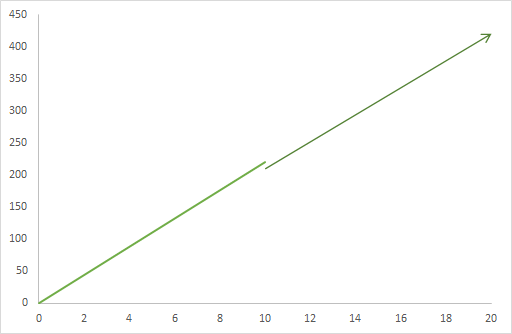
If you look closely, you can see that the graph is discontinuous at $x = 1$ which is consistent with the function's limits:
$$lim_limits{x\to10^-} = 22 \cdot 10 = 220$$ $$lim_limits{x\to10^+} = 21 \cdot 10 = 210$$Referring to the scenario in the previous question, how does the situation change if the company charges a flat €20 shipping charge for orders over 10 units?
$$C(x) = \begin{cases} 22x, & x\le10 \\ 20x + 20, & x\gt10 \end{cases}$$
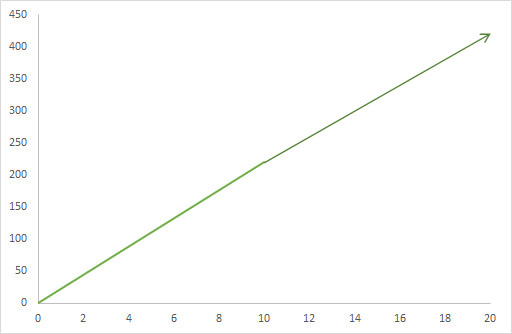
These values are the same so this function is continuous at $x=10$.
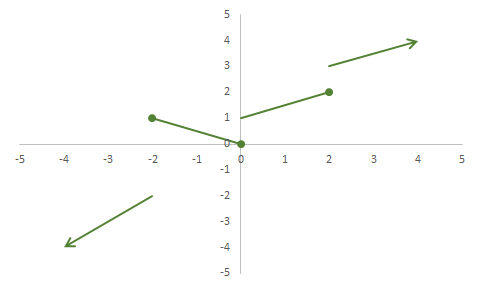
Give an example of the graph of a function that's discontinuous at three points.
There are many possibilities. This graph has jump discontinuities at $x=-2$, $x=0$ and $x=2$.
Give an example of the graph of a function has removable discontinuities at $x=\pm1$.
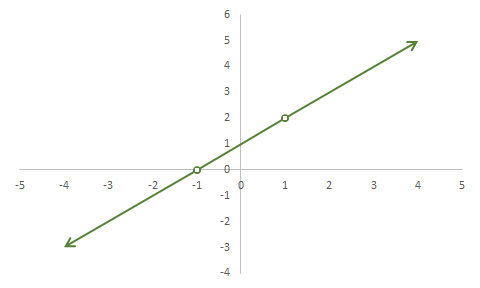
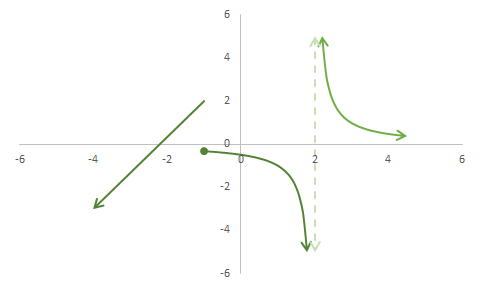
Give an example of the graph of a function two different types of discontinuities.
There are many possiblities. The functeion below has a jump discontinuity at $x=-1$ and an infinite discontinuity at $x=2$.
Use the properties of continuity discussed in the lectures to show that the $g(x)=\sqrt{\frac{x+1}{x-1}}$ is continuous everywhere that it's defined.
Polynomials are continuous so, individually, the numerators and denominators are continuous.
The ratio of two continuous functions is continuous wherever the ratio is defined.
Finally, the square root of a continuous function is continuous wherever the function is defined.
Use the properties of continuity discussed in the lectures to show that the $g(x)=\tan(x)$ is continuous everywhere that it's defined.
$$ an(x) = \frac{\sin(x)}{\cos(x)}$$
Use the properties of continuity discussed in the lectures to show that the $g(x)=\tan(x)$ is continuous everywhere that it's defined.
$$ an(x) = \frac{\sin(x)}{\cos(x)}$$
Since the sine and cosine are both continuous, their ratio is continuous everywhere the ratio is defined.
Use the properties of continuity discussed in the lectures to show that the $f(x)=\cos(2x)$ is continuous everywhere that it's defined.
Method 1
$g(x) = 2x$ is continuous and, if $h(x) = \cos(x)$ then $f(x) = h(g(x))$. Since h and g are both continuous, so is their composition.
Method 2
$f(x) = \cos(2x) = \cos^2(x) - \sin^2(x)$. Since the sine and cosine are continuous so are their squares and, since the squares are continuous, so is their difference.
Explain why $ f(x) = \begin{cases} \frac{1}{(x+1)^2}, & x \neq -1 \\ 2, & x = -1 \end{cases}$ is discontinuous at $a=-1$.
The function is defined at $x=-1$ and the limit at that point exists ($\lim_\limits{x\to-1}f(x) = \infty$). However
$$\lim_\limits{x\to-1}f(x) \ne f(-1) = 2$$which is why the limit doesn't exist.
Explain why $f(x)=\frac{x^2+2x+1}{x+1}$ is discontinuous at $a=-1$
The function isn't defined at $x=1$ so it can't be continuous there.
Explain why $f(x)=\tan(x)$ is discontinuous at $a=\pi/2$
The function isn't defined at $x=\pi/2$ so it can't be continuous there.
Explain why $f(x)=\lfloor x\rfloor$ is discontinuous at $a=3$
The floor function is defined at $x=3$ so that isn't an issue. However,
$$\lim_\limits{x\to3^-}=2$$and
$$\lim_\limits{x\to3^+}=3$$So the function isn't defined since the left and right limits aren't the same.
For the function $ f(x) = \begin{cases} x+1, & x \le2 \\ 2x+a, & x \gt 2 \end{cases}$ find a value of a that makes the function continuous.
a = -1
For the fuction $ f(x) = \begin{cases} \frac{x^2+3x+2}{x+1}, & x \neq -1 \\ a, & x = -1 \end{cases}$, find a value of a that makes the function continuous.
The function simplifies to
$$ f(x) = \begin{cases} \frac{x^2+3x+2}{x+1}, & x \neq -1 \\ a, & x = -1 \end{cases} = \begin{cases} \frac{(x+1)(x+2)}{x+1}, & x \neq -1 \\ a, & x = -1 \end{cases} =\begin{cases} x+2, & x \neq -1 \\ a, & x = -1 \end{cases} $$From here, we can see that
$$\lim_\limits{x\to-1}f(x)=-1+2 = 1$$To be continuous $f(-1)$ has to equal that value. Since $f(-1)=a$ this means that $a=1$.
For the function $ f(x) = \begin{cases} x+2, & x \le 1 \\ x^2+ax+b, & x \gt 1 \end{cases}$ find a value of a that makes the function continuous.
a = 2 - b
For the fuction $ f(x) = \begin{cases} \cos(x+a), & x \le 0 \\ \sin(x), & x \gt 0 \end{cases}$, find a value of a that makes the function continuous.
For the function to be continuous we have to have
$$\lim_\limits{x\to0^-}f(x)=\lim_\limits{x\to0^+}f(x)$$ $$\cos(0+a)=\sin(0)$$ $$\cos(a)=0$$For this to be true a can be any odd integer multiple of $\pi/2$, i.e. $a=\frac{(2k+1)\pi}{2}$ for any integer k.
For the function $ f(x) = \begin{cases} 3x-1, & x \le -1 \\ x^2+ax+b, & -1\lt x\le1 \\ ax, & x\gt1 \end{cases}$ find a value of a that makes the function continuous.
a = 4, b = -1
For the fuction $ f(x) = \begin{cases} ax^2+bx+1, & x \le -2 \\ ax^3+2b, & -2\lt x\le1 \\ ax-b+3, & x\gt1 \end{cases}$, find a value of a that makes the function continuous.
Start with the left and right limits at -2 and 1.
| $$\lim_\limits{x\to-2^-}f(x) = \lim_\limits{x\to-2^+}f(x)$$ $$a(-2)^2+b(-2)+1=a(-2)^3+2b$$ $$4a-2b+1=-8a+2b$$ $$12a-4b=1$$ | $$\lim_\limits{x\to1^-}f(x) = \lim_\limits{x\to1^+}f(x)$$ $$a(1)^3+2b = a\cdot1-b+3$$ $$a+2b = a-b+3$$ $$3b = 3$$ $$b = 1$$ |
Substiting $b=1$ into the first equation gives us
$$12a-4b=1$$ $$12a-4\cdot1=1$$ $$12a-4=1$$ $$12a=5$$ $$a=\frac{5}{12}$$So the required values are $a=\frac{5}{12}$ and $b=1$.
Use the Intermediate Value to either confirm that $f(x) = \cos(\pi x+1)$ has a root on the interval [0, .5].
$$f(0) = \cos(\pi \cdot 0+1) = \cos(1) \approx 0.540$$ $$f(.5) = \cos(\pi \cdot .5+1) = \cos(2.571) \approx -0.841$$
Since $f(0) \gt 0$ and $f(.5) \lt 0$ the Intermediate Value Theorem says that there must be a point on the interval [0, 0.5] where the function equals 0.
Use the Intermediate Value to find an interval on which $g(x) = 4\cos(x) + x$ has a root.
$$g(\pi) = -4 + \pi < 0$$ $$g(0) = 4 > 0$$
Since $g(0) \gt 0$ and $g(\pi) \lt 0$ the Intermediate Value Theorem says that there must be a point on the interval [0, π] where the function equals 0.
Explain how you would use continuity to evaluate $\lim\limits_{x\to-\pi}(\cos(2x + \sin(x))$.
Since the cosine function is continuous
$$\lim\limits_{x\to-\pi}(\cos(2x + \sin(x))=\cos\left(\lim\limits_{x\to-\pi}(2x + \sin(x))\right)$$Finally, since $2x + \sin(x)$ is the product and sum of continuous functions, it must also be continuous so
$$\lim\limits_{x\to-\pi}(\cos(2x + \sin(x))=\cos\left(\lim\limits_{x\to-\pi}(2x + \sin(x))\right)=\cos\left(2\cdot \pi + \sin(\pi)\right)=\cos(2\pi) = 1$$$f(x)=\cos(x)$ has a solution on the interval $[-\pi/4, \pi/4]$ even though $\cos(-\pi/4)$ and $\cos(\pi/4)$ are both greater than 0. Explain how this is consistent with the Intermediate Value Theorem.
The Intermediate Value tells us what has to happen if the function values at the end points of the interval have different signs. It doesn't say anything about what happens if the two values have the same sign.