


Section 1.6 - Continuity
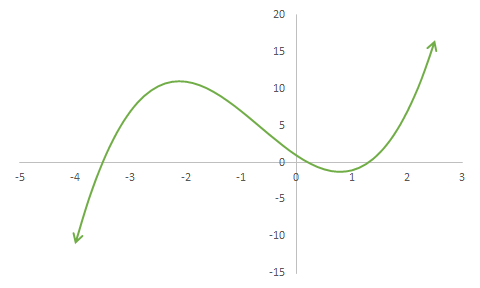
For most of the rest of the class, we're going to be focused on functions that are, in a sense, "well-behaved". These are functions that don't have any gaps, jumps or breaks - what we're going to call "continuous". The heuristic way this is usually described to students is, a continuous function is one that you whose graph you can draw without picking up your pencil like the one below.
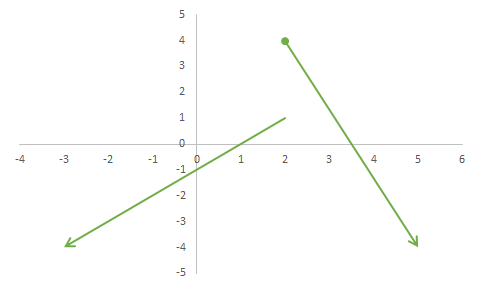
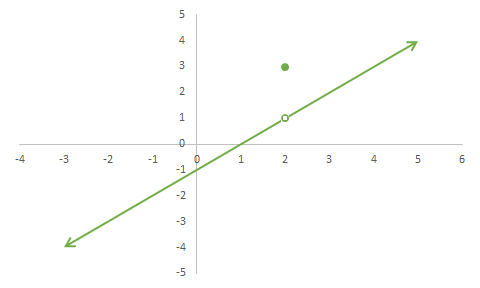
Our definition of continuity is going to be based on ruling out situations that make a function not continuous or "discontinuous". The three graphs below are all discontinuous at $x = 2$, each for a different reason. See if you can describe what's creating the gap or break in each graph at that point in terms of limits. We'll look at all of these situations in more detail and use them to derive our formal definition of continuity in the following lectures.
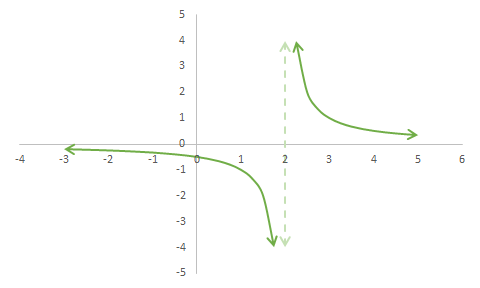


Think about the function's domain.
This function is defined at $x=2$ but the edges don't line up. In other words
$$\lim\limits_{x\to2^+}f(x) \ne \lim\limits_{x\to2^-}f(x)$$This function is defined at $x=2$ and the edges line up but they don't match the actual value of the function at that point. In other words
$$\lim\limits_{x\to2}f(x) \ne f(2)$$