


Exercises
 : shows the complete answer. |  : gives a hint |
 : plays a video solution |  : shows just the final answer |
 : these are important examples that illustrate new concepts, you should be sure to review the solutions to these questions | |
Exercises
Use the function $ f(x) = \begin{cases} 3x+1, & x \lt 2 \\ 6, & x = 2\\ x+7, & x \gt 2 \end{cases}$ to answer the following questions.
|
|
|
Use the function $ g(x) = \begin{cases} x^2+1, & x \le 0 \\ 1, & 0 \lt x \lt 2\\ -2x+4, & x \ge 2 \end{cases}$ to answer the following questions.
|
|
|
|
|
|
Use the function $ h(x) = \begin{cases} \sin\left(\frac{1}{x}\right), & x \gt 0 \\ 0, & x \le 0 \end{cases}$ to answer the following questions. (Hint: We looked at the $\sin\left(\frac{1}{x}\right)$ function in the last section's exercises.)
|
|
|
Find the following limits.
|
|
|
|
|
|
|
|
|
|
|
|
Let $\lfloor x\rfloor$ be the "greatest integer" function, also called a "floor" function. $\lfloor x\rfloor$ is defined to the greatest integer that's less than or equal to x. Use this function to answer the following questions.
- Sketch the graph of $f(x) = \lfloor x \rfloor$.
- At what points does $\lim\limits_{x\to c} \lfloor x \rfloor$ not exist?
- Give formulas for $\lim\limits_{x\to n^+} \lfloor x \rfloor$ and $\lim\limits_{x\to n^-} \lfloor x \rfloor$ when n is an integer.
|
|
|
|
|
Icons courtesy of icons8.com
Use the function $f(x) =\begin{cases}3x+1, & x \lt 2 \\6, & x = 2\\x+7, & x \gt 2\end{cases}$ to find $\lim\limits_{x\to2^+}f(x)$
Numbers to the right of 2 are numbers in the range $x > 2$.
Use the function $f(x) =\begin{cases}3x+1, & x \lt 2 \\6, & x = 2\\x+7, & x \gt 2\end{cases}$ to find $\lim\limits_{x\to2^+}f(x)$
On the right side of 2, the function looks like $f(x) = x + 7$ and $\lim\limits_{x\to2}(x + 7) = 9$ so $\lim\limits_{x\to2^+}f(x) = 9$.
Use the function $f(x) =\begin{cases}3x+1, & x \lt 2 \\6, & x = 2\\x+7, & x \gt 2\end{cases}$ to find $\lim\limits_{x\to2^-}f(x)$
On the left side of 2, the function looks like $f(x) = 3x + 1$ and $\lim\limits_{x\to2}(3x + 1) = 10$ so $\lim\limits_{x\to2^-}f(x) = 10$.
Use the function $f(x) =\begin{cases}3x+1, & x \lt 2 \\6, & x = 2\\x+7, & x \gt 2\end{cases}$ to find $\lim\limits_{x\to2}f(x)$
Since $\lim\limits_{x\to2^+}f(x) = 9$ and $\lim\limits_{x\to2^-}f(x) = 10$, the left and right hand limits aren't equal so $\lim\limits_{x\to2}f(x)$ doesn't exist.
Use the function $g(x) =\begin{cases}x^2+1, & x \le 0 \\1, & 0 \lt x \lt 2\\-2x+4, & x \ge 2\end{cases}$ to find $\lim\limits_{x\to0^-}g(x)$
$$\lim\limits_{x\to0^+}g(x) = 1$$
Use the function $g(x) =\begin{cases}x^2+1, & x \le 0 \\1, & 0 \lt x \lt 2\\-2x+4, & x \ge 2\end{cases}$ to find $\lim\limits_{x\to0^-}g(x)$
To the left of 0 are the numbers $x \le 0$ so
$$\lim\limits_{x\to0^-}g(x) = 0^2 + 1 = 1$$Use the function $g(x) =\begin{cases}x^2+1, & x \le 0 \\1, & 0 \lt x \lt 2\\-2x+4, & x \ge 2\end{cases}$ to find $\lim\limits_{x\to0}g(x)$
As we saw in the previous two questions, the left and right hand limits aren't equal so this limit doesn't exist.
Use the function $g(x) =\begin{cases}x^2+1, & x \le 0 \\1, & 0 \lt x \lt 2\\-2x+4, & x \ge 2\end{cases}$ to find $\lim\limits_{x\to2^-}g(x)$
$$\lim\limits_{x\to2^-}g(x) = 1$$
Use the function $h(x) = \begin{cases}\sin\left(\frac{1}{x}\right), & x \gt 0 \\0, & x \le 0\end{cases}$ to find $\lim\limits_{x\to0^+}h(x)$
$$\lim\limits_{x\to0^+}h(x) \text{ does not exist}$$
Use the function $h(x) = \begin{cases}\sin\left(\frac{1}{x}\right), & x \gt 0 \\0, & x \le 0\end{cases}$ to find $\lim\limits_{x\to0^-}h(x)$
$$\lim\limits_{x\to0^-}h(x) = 0$$
Evaluate $\lim\limits_{x\to2^+}\frac{x^2+1}{x-3}$.
Neither the numerator or denominator is equal to 0 at $x = 2$ so
$$\lim\limits_{x\to2^+}\frac{x^2+1}{x-3} = \lim\limits_{x\to2^+}\frac{x^2+1}{x-3} = \frac{2^2+1}{2-3} = -5 $$Evaluate $\lim\limits_{x\to2^+}\frac{x}{x-1}\cdot \frac{x-1}{x-2} \cdot \frac{x-2}{x-3}$.
The function can't be simplified any further and the function is unbounded when x gets closer to 2 on either side so this limit doesn't exist. We'll talk more about this situation in the next section.
Evaluate $\lim\limits_{x\to3^-}(x-1)(x-2)(x-3)$.
Notice that this is just a polynomial.
Evaluate $\lim\limits_{x\to3^-}(x-1)(x-2)(x-3)$.
This function is a polynomial so it's limit at $x = a$ is equal to $f(a)$ for all real numbers so
$$\lim\limits_{x\to3^-}(x-1)(x-2)(x-3) = \lim\limits_{x\to3}(x-1)(x-2)(x-3) = (3-1)(3-2)(3-3) = 0$$Evaluate $\lim\limits_{x\to2^-}\frac{x-2}{x-2}$.
$$\lim\limits_{x\to2^-}\frac{x-2}{x-2} = 1$$
Evaluate $\lim\limits_{x\to2^-}\frac{x-2}{x-2}$.
$$\lim\limits_{x\to2^-}\frac{x-2}{x-2} = 1$$
Evaluate $\lim\limits_{x\to2}\frac{|x-2|}{|x-2|}$.
$$\lim\limits_{x\to2}\frac{|x-2|}{|x-2|} = 1$$
Evaluate $\lim\limits_{x\to2^-}\frac{x-2}{|x-2|}$.
On the left side of 2, $|x - 2| = -(x - 2)$ so
$$\lim\limits_{x\to2^-}\frac{x-2}{|x-2|}= \lim\limits_{x\to2^-}\frac{x-2}{-(x-2)}= \lim\limits_{x\to2^-}(-1) = -1$$Evaluate $\lim\limits_{x\to2^+}\frac{x-2}{|x-2|}$.
$$\lim\limits_{x\to2^+}\frac{x-2}{|x-2|} = 1$$
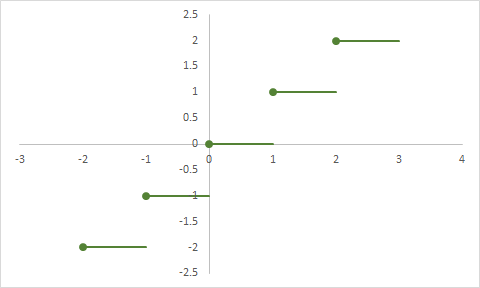
Sketch the graph of $f(x) = \lfloor x \rfloor$.
Try picking five or six points between 0 and 1, including 0 and 1.
Sketch the graph of $f(x) = \lfloor x \rfloor$.
Think about some points between 0 and 1:
| x | $y = \lfloor x \rfloor $ |
| 0.0 | 0 |
| 0.2 | 0 |
| 0.5 | 0 |
| 0.6 | 0 |
| 1.0 | 1 |
If you extend the table to values between 1 and 2, you'll see the same pattern repeat: The y values stay at 2 until you get to 3 when they jump. Graphically, this looks like:
At what points does $\lim\limits_{x\to c} \lfloor x \rfloor$ not exist?
You can see from the graph that the left and right limits are different at every integer value of x so those are the points where the limit won't exist. We'll talk more about this in the last section when we talk about continuity.
Give formulas for $\lim\limits_{x\to n^+} \lfloor x \rfloor$ and $\lim\limits_{x\to n^-} \lfloor x \rfloor$ when n is an integer.
$$\lim\limits_{x\to n^-} \lfloor x \rfloor = n - 1$$ $$\lim\limits_{x\to n^+} \lfloor x \rfloor = n$$
Evaluate $\lim\limits_{x\to 0^+} \frac{x}{\lfloor x \rfloor}$.
Think about where the function is undefined.
Evaluate $\lim\limits_{x\to 0^+} \frac{x}{\lfloor x \rfloor}$.
Since $\lfloor x \rfloor\ = 0$ for $0 \le x \lt 1$, $\frac{x}{\lfloor x \rfloor}$ is undefined in that range. More specifically, it's undefined on the right side of 0 so the limit doesn't exist.
Evaluate $\lim\limits_{x\to 0^-} \frac{x}{\lfloor x \rfloor}$.
Think about what $\lfloor x \rfloor$ equals for values of x between -1 and 0.
Evaluate $\lim\limits_{x\to 0^-} \frac{x}{\lfloor x \rfloor}$.
For values of x where $-1 \le x \lt 0$, $\lfloor x \rfloor\ = -1$ so
$$\lim\limits_{x\to 0^-} \frac{x}{\lfloor x \rfloor} = \lim\limits_{x\to 0^-} \frac{x}{-1} = 0$$Evaluate $\lim\limits_{x\to 1} 2\lfloor x \rfloor$.
$$\lim\limits_{x\to 1} 2\lfloor x \rfloor \text{ doesn't exist}$$
Evaluate $\lim\limits_{x\to 1} 2\lfloor \frac{x}{2} \rfloor$.
$$\lim\limits_{x\to 1} \lfloor \frac{x}{2} \rfloor = 0$$
Evaluate $\lim\limits_{x\to 3^-} (x - \lfloor x \rfloor)$.
$x - \lfloor x \rfloor$ is the decimal part of x.
Evaluate $\lim\limits_{x\to 3^-} (x - \lfloor x \rfloor)$.
$$\lim\limits_{x\to 3^-} (x - \lfloor x \rfloor) = 1$$
