


Section 1.3 - Vector Equations, Matrix Equations and Linear Transformations
Vectors
A vector is an $n\times 1$ or $1 \times n$ matrix, e.g.
| $\mathbf{u} = \begin{bmatrix}1 & 2 & 3\end{bmatrix}$ | $\mathbf{v} = \begin{bmatrix}1 \\ 2 \\ 3\end{bmatrix}$ |
| row matrix | column matrix |
Algebraic Properties of Vextors
Vectors share a lot of the common algebraic properties you're used to seeing with numbers
| commutativity: | $\mathbf{u} + \mathbf{v} = \mathbf{v} + \mathbf{u}$ | distribution of scalars: | $c(\mathbf{u} + \mathbf{v}) = c\mathbf{v} + c\mathbf{u}$ |
| associativity: | $(\mathbf{u} + \mathbf{v}) + \mathbf{w} = \mathbf{v} + (\mathbf{u} + \mathbf{w})$ | distribution of vectors: | $(c+d)\mathbf{u} = c\mathbf{u} + d\mathbf{u}$ |
| additive identity: | $\mathbf{u} + \mathbf{0} = \mathbf{u}$ | multiplicative identity: | $1\mathbf{u} = \mathbf{u}$ |
| additive inverse: | $\mathbf{u} + (-\mathbf{u}) = \mathbf{0}$ | multiplicative identity: | $1\mathbf{u} = \mathbf{u}$ |
Linear Combinations
DEFINITION: Given a set of vectors $\mathbf{u_1}, \mathbf{u_2}, ..., \mathbf{u}_m\in\mathbb{R}^n$ and a set of scalars, $c_1, c_2, ..., c_m$ called weights, the vector defined by
$$v=c_1\mathbf{u_1} + c_2\mathbf{u_2} + ... + c_m\mathbf{u_m}$$is called a linear combination of the vectors.
Spans
DEFINITION: Given a set of vectors $\mathbf{u_1}, \mathbf{u_2}, ..., \mathbf{u}_m\in\mathbb{R}^n$ then the set of all linear combinations of $\mathbf{u_1}, \mathbf{u_2}, ..., \mathbf{u}_m$ is called the span generated by the vectors. This is written $\text{Span}\{\mathbf{u_1}, \mathbf{u_2}, ..., \mathbf{u}_m\}$.
The Geometry of Spans
 |
 |
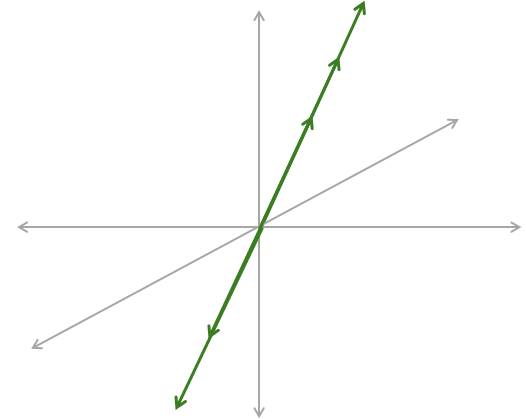
| $\text{Span}\{\mathbf{u}\}$ The span of a single vector is a line |
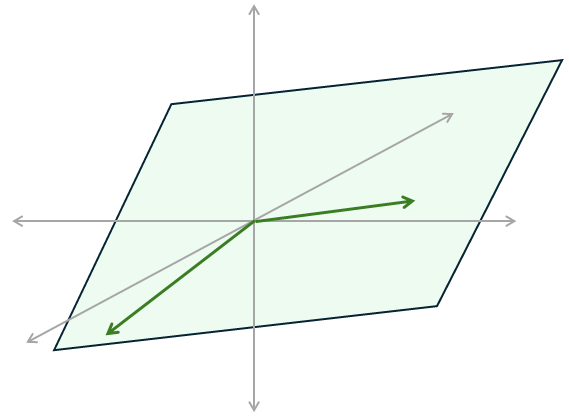
$\text{Span}\{\mathbf{u}, \mathbf{v}\}$ The span of two vectors is a plane if one isn't a multiple of the other. |
The Matrix Equation
The following definition defines the product of a matrix and a vector as a linear combination of the matrix's columns with the elements of the vector as the weights.
DEFINITION: If $A$ is an $m\times n$ matrix with columns $a_1, a_2, ..., a_n$ and $x\in\mathbb{R}^n$ then
$$A\mathbf{x} = \begin{bmatrix}\mathbf{a}_1 & \mathbf{a}_2 & ... & \mathbf{a}_n\end{bmatrix}\begin{bmatrix}x_1 \\ x_2 \\ ... \\x_n\end{bmatrix} = x_1\mathbf{a}_1 + x_2\mathbf{a}_2 + ... + x_n\mathbf{a}_n$$THEOREM: If $A$ is an $m \times n$ matrix with columns $\mathbf{u_1}, \mathbf{u_2}, ..., \mathbf{u}_n$ and $\mathbf{b}\in\mathbb{R}^m$ then the equation
$$A\mathbf{x} = \mathbf{b}$$has the same solution set as the vector equation
$$x_1\mathbf{u_1} + x_2\mathbf{u_2} + ... + x_n\mathbf{u_n} = \mathbf{b}$$which has the same solution set as the system of lienar equations whose augmented matrix is
$$\begin{bmatrix}\mathbf{a}_1 & \mathbf{a}_2 & ... & \mathbf{a}_n & \mathbf{b}\end{bmatrix}$$The Matrix Equation vs. Spans vs. Systems of Linear Equations vs. Linear Combinations
The following theorem connects all of the concepts that we've discussed so far in the class.
THEOREM: Let $A$ be an $m\times n$ matrix. Then the following statements are equivalent:
- For every $\mathbf{b}\in\mathbb{R}^m$, the equation $A\mathbf{x} = \mathbf{b}$ has a solution.
- Every $\mathbf{b}\in\mathbb{R}^n$ is a linear combination of the columns of $A$.
- The columns of $A$ span $\mathbb{R}^n$.
- $A$ has a pivot position in every row.
For a proof of this theorem see the Two Proofs page in this section.
What this kind of theorem is saying that each of the four statements implies each of the others and in both directions, e.g.
Statement (3) implies statement (4): If the columns of $A$ span $\mathbb{R}^n$ then $A$ has a pivot position in every row.
Statement (4) implies statement (2): If $A$ has a pivot position in every row then every $\mathbf{b}\in\mathbb{R}^n$ is a linear combination of the columns of $A$.
Etc. for every combination of the four statements.
