


The Row Reduction Algorithm
In algebra and pre-calculus classes, the method used for solving systems of linear equations is "intuitive". It's based on looking at the system and saying to yourself things like, "Well . . . that term doesn't have a coefficient so if I start there I can easily use it to eliminate all the other versions of that variable." That's fine for a human but computers need something more precise. In this next series of lectures, we're going to develop something called a "row reduction algorithm" that we can use to analyze any system of equations with the goal of finding its solutions set in a much more analytic and procedural way and, along the way, we'll also come up with a rule for determining whether or not a system of equations has a solution and, if it does, how many.
Echelon Forms
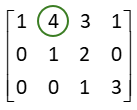
The first step in a structured algorithm is getting the augmented matrix into what's called the row echelon form. The definition is based on the vavlues in leading entries, i.e. the leftmost, non-zero entry in a non-zero row.
A matrix is in echelon form (or row echelon form) if it has these properties.
- All nonzero rows are above any rows of all zeros.
- Each leading entry of a row is in a column to the right of the leading entry of the row above it.
- All entries in a column below a leading entry are zeros.
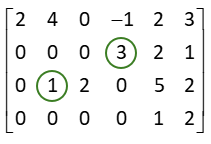 |
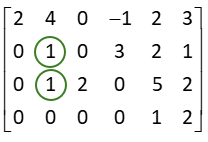 |
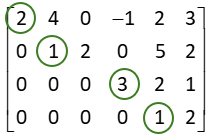 |
| not in the echelon form property (2) isn't satisfied |
not in the echelon form property (3) isn't satisfied |
is in the echelon form |
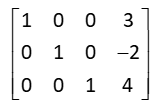
A matrix is in the reduced echelon form (or reduced row echelon form) if it has these properties.
- It's in the echelon form.
- The leading entry in each nonzero row is 1.
- Each leading 1 is the only nonzero entry in its column.
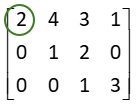 |
 |
 |
| not in the reduced echelon form property (2) isn't satisfied |
not in the reduced echelon form property (3) isn't satisfied |
is in the reduced echelon form |
Theorem: The echelon form isn't unique. The reduced row echelon form is unique.
A pivot position in a matrix is a location that corresponds to a leading 1 in the reduced echelon form. A pivot column is a column of a matrix that contains a pivot position. The values in the pivot positions are called pivots.
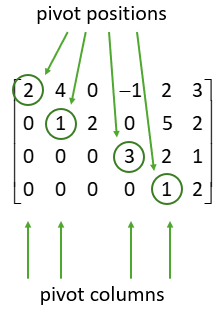
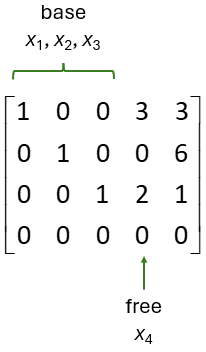
Variables corresponding to pivot columns are called base variables. Variables corresponding to non-pivot columns are called free variables.
The Row Reduction Algorithm
| Step 1: | Start with the leftmost nonzero column. This will always be a pivot column with the pivot at the top. |
| Step 2: | Select a nonzero entry in the column to be the pivot. If necessary, switch rows to get this entry into the pivot position. |
| Step 3: | Use row operations to make all values below the pivot 0. |
| Step 4: | Cover the row with the pivot column and any rows above it then repeat steps 1 through 3 until there are no remaining nonzero rows. |
| Step 5: | At this point, the matrix should be in an echelon form. Working up and to the left from the rightmost pivot, scale each pivot to 1 then use it to create zeroes above each pivot. |
Theorem (Existence and Uniqueness): A system of linear equations is consistent if and only if the rightmost column of the augmented matrix is not a pivot column, i.e. if and only if an echelon form of the augmented matrix has no row of the form
$$\begin{bmatrix} 0&...&0&a \end{bmatrix}$$where $a$ is nonzero. If a linear system is consistent, then either
- there are no free variables and the system has a unique solution or
- there is at least one free variable and the system has infinitely many solutions
