


Matrices vs. Systems of Equations
Systems of Linear Equations vs. Matrices
A system of linear equations in the variables $x_1$, $x_2$, ..., $x_n$ is a collection of one or more linear equations involving the same variables:
$$ a_{11}x_1 + a_{12}x_2 + ... + a_{1n}x_n = b_1 \\ a_{21}x_1 + a_{22}x_2 + ... + a_{2n}x_n = b_2 \\ . . . \\ a_{m1}x_1 + a_{m2}x_2 + ... + a_{mn}x_n = b_m $$A matrix is a collection of numbers and/or variables arranged in rows and columns. A system of linear equations can be converted into an equivalent matrix based on its coefficients.
|
$3x_1 + 4x_2 + 4x_3 = -1$ $-2x_1 + 5x_2 + 3x_3 = 2$ $x_1 + 2x_2 - 2x_3 = -3$ |
⇔ | $\begin{bmatrix} 3 & 4 & 4 \\ -2 & 5 & 3 \\ 1 & 2 & -2 \end{bmatrix}$ | ⇔ | $\begin{bmatrix} 3 & 4 & 4 & -1\\ -2 & 5 & 3 & 2\\ 1 & 2 & -2 & -3 \end{bmatrix}$ |
| system of linear equations | coefficient matrix | augmented matrix |
Solution Sets
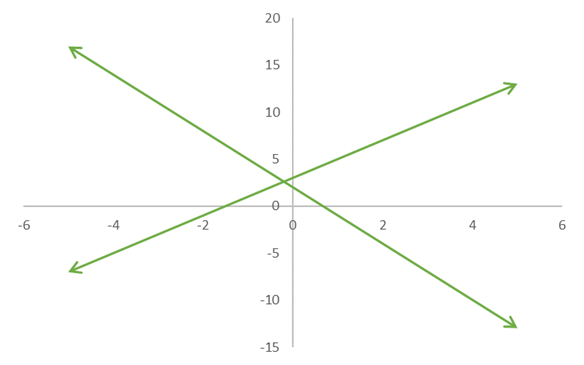
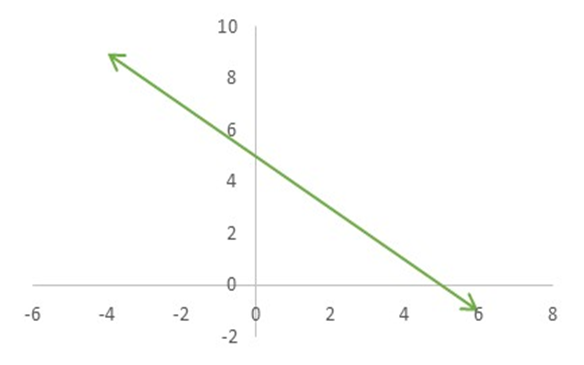
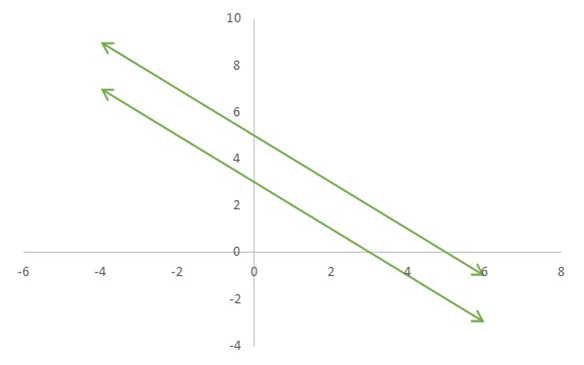
A solution to the system is a list of numbers, $(s_1, s_2, ..., s_n)$ that satisfies all of the equations in the system. The set of all possible solutions to a system is called the solution set. There are three possible sizes for the solution sets that we'll put into two categories:
 |
 |
 |
|
| Case 1: one solution | Case 2: infinitely many solutions | Case 3: no solutions | |
| consistent systems (have solutions) | inconsistent systems (no solutions) | ||
Elementary Row Operations
Two matrices are row equivalent if one can be transformed into another by a sequence of elementary row operations. If the augmented matrices o two linear systems are row equivalent then their corresponding systems of equations have the same solutions.
| Transpose Rows | Scale a Row | Combine Rows |
| switch two rows | multiply every value of a row by a constant | multiply every value of a row by a constant and add those values to another row |
| $\begin{bmatrix} a & b & c\\ d & e & f \end{bmatrix} \Leftrightarrow \begin{bmatrix} d & e & f \\ a & b & c \end{bmatrix}$ | $\begin{bmatrix} a & b & c\\ d & e & f \end{bmatrix} \Leftrightarrow \begin{bmatrix} a & b & c\\ md & me & mf \end{bmatrix}$ | $\begin{bmatrix} a & b & c\\ d & e & f \end{bmatrix} \Leftrightarrow \begin{bmatrix} a & b & c\\ ma + d & mb + e & mc + f \end{bmatrix}$ |
